 Indietro
Common Cations and Anions: Essential Reference for Ionic Compounds
Guida di studio - Note intelligenti
 Appunti personalizzati basati sui tuoi materiali, ampliati con definizioni chiave, esempi e contesto.
Ionic Compounds
Common Cations
Ions are atoms or molecules that carry an electric charge due to the loss or gain of electrons. Cations are positively charged ions formed when atoms lose electrons. Understanding common cations is fundamental for naming and writing formulas of ionic compounds in chemistry.
Charge: Cations are classified by their positive charge (e.g., 1+, 2+, 3+).
Formula: The chemical symbol with charge notation (e.g., Na+).
Name: The systematic or common name of the ion (e.g., sodium ion).
Examples: Hydrogen ion (H+), sodium ion (Na+), calcium ion (Ca2+), iron(III) ion (Fe3+).
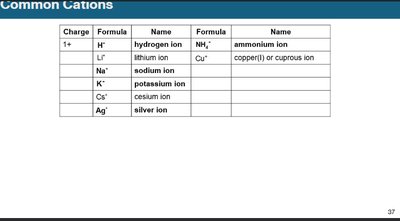
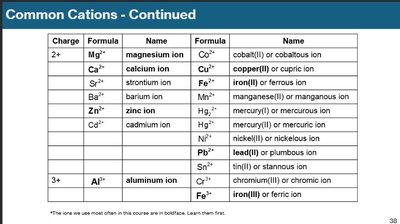
Below is a table summarizing the most common cations encountered in introductory chemistry:
Key Points:
Monatomic cations are named by adding "ion" to the element name (e.g., potassium ion).
Polyatomic cations include ions like ammonium (NH4+).
Transition metals often form more than one cation, distinguished by Roman numerals (e.g., iron(II) vs. iron(III)).
Example: The copper(I) ion is Cu+, while copper(II) is Cu2+.
Common Anions
Anions are negatively charged ions formed when atoms gain electrons. Recognizing common anions is essential for constructing and naming ionic compounds.
Charge: Anions are classified by their negative charge (e.g., 1-, 2-, 3-).
Formula: The chemical symbol with charge notation (e.g., Cl-).
Name: The systematic or common name of the ion (e.g., chloride ion).
Examples: Fluoride ion (F-), sulfate ion (SO42-), phosphate ion (PO43-).
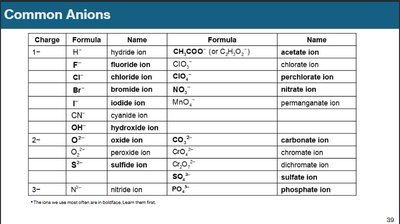
Below is a table summarizing the most common anions encountered in introductory chemistry:
Key Points:
Monatomic anions are named by replacing the element's ending with "-ide" (e.g., chloride, oxide).
Polyatomic anions have specific names (e.g., nitrate, sulfate, phosphate).
Some polyatomic ions have multiple forms distinguished by prefixes and suffixes (e.g., chlorate, perchlorate).
Example: The sulfate ion is SO42-, while the sulfite ion is SO32-.
Summary Table: Cations and Anions
The following HTML tables summarize the main cations and anions from the images above:
Common Cations
Charge | Formula | Name | Formula | Name |
|---|---|---|---|---|
1+ | H+ | hydrogen ion | NH4+ | ammonium ion |
Li+ | lithium ion | Cu+ | copper(I) or cuprous ion | |
Na+ | sodium ion | |||
K+ | potassium ion | |||
Cs+ | cesium ion | |||
Ag+ | silver ion | |||
2+ | Mg2+ | magnesium ion | Co2+ | cobalt(II) or cobaltous ion |
Ca2+ | calcium ion | Cu2+ | copper(II) or cupric ion | |
Sr2+ | strontium ion | Fe2+ | iron(II) or ferrous ion | |
Ba2+ | barium ion | Mn2+ | manganese(II) or manganous ion | |
Zn2+ | zinc ion | Hg2+ | mercury(II) or mercuric ion | |
Cd2+ | cadmium ion | Hg22+ | mercury(I) or mercurous ion | |
Ni2+ | nickel(II) or nickelous ion | |||
Pb2+ | lead(II) or plumbous ion | |||
Sn2+ | tin(II) or stannous ion | |||
3+ | Al3+ | aluminum ion | Cr3+ | chromium(III) or chromic ion |
Fe3+ | iron(III) or ferric ion |
Common Anions
Charge | Formula | Name | Formula | Name |
|---|---|---|---|---|
1- | H- | hydride ion | CH3COO- (or C2H3O2-) | acetate ion |
F- | fluoride ion | ClO3- | chlorate ion | |
Cl- | chloride ion | ClO4- | perchlorate ion | |
Br- | bromide ion | NO3- | nitrate ion | |
I- | iodide ion | MnO4- | permanganate ion | |
CN- | cyanide ion | |||
OH- | hydroxide ion | |||
2- | O2- | oxide ion | CO32- | carbonate ion |
O22- | peroxide ion | CrO42- | chromate ion | |
S2- | sulfide ion | Cr2O72- | dichromate ion | |
SO42- | sulfate ion | |||
SO32- | sulfite ion | |||
3- | N3- | nitride ion | PO43- | phosphate ion |
Additional info: These tables are essential for GOB Chemistry students to master the naming and formula writing of ionic compounds, which is foundational for later topics such as chemical reactions, solution chemistry, and acid-base chemistry.
