 Indietro
Covalent Bonding and Naming Covalent Compounds: Guided Study
Guida di studio - Note intelligenti
 Appunti personalizzati basati sui tuoi materiali, ampliati con definizioni chiave, esempi e contesto.
Q1. What kinds of elements (metals or nonmetals) are present in ionic compounds?
Background
Topic: Ionic vs. Covalent Compounds
This question is testing your ability to distinguish between ionic and covalent compounds based on the types of elements involved.
Key Terms:
Metals: Elements that tend to lose electrons and form positive ions (cations).
Nonmetals: Elements that tend to gain electrons and form negative ions (anions).
Ionic Compound: A compound formed from the electrostatic attraction between cations and anions.
Step-by-Step Guidance
Look at the examples of ionic compounds provided (e.g., NaCl, MgBr2, CaO, KI).
Identify which elements are metals and which are nonmetals in each compound.
Notice the pattern: ionic compounds typically contain at least one metal and one nonmetal.
Think about why metals and nonmetals combine to form ionic compounds (hint: electron transfer).
Try solving on your own before revealing the answer!
Final Answer:
Ionic compounds are composed of metals and nonmetals. The metal loses electrons to become a cation, and the nonmetal gains electrons to become an anion.
Q2. What kinds of elements (metals or nonmetals) are present in covalent compounds?
Background
Topic: Covalent Compounds
This question is testing your understanding of the types of elements that form covalent compounds.
Key Terms:
Covalent Compound: A compound formed when two or more nonmetals share electrons.
Nonmetals: Elements that tend to share electrons rather than transfer them.
Step-by-Step Guidance
Examine the examples of covalent compounds (e.g., H2O, CH4, N2O, CO2).
Identify the types of elements present in these compounds.
Notice that covalent compounds are made up of only nonmetals.
Think about why nonmetals share electrons instead of transferring them.
Try solving on your own before revealing the answer!
Final Answer:
Covalent compounds are composed of only nonmetals. These elements share electrons to achieve a stable electron configuration.
Q3. What happens to valence electrons in an ionic compound?
Background
Topic: Ionic Bonding
This question is testing your understanding of how valence electrons behave during the formation of ionic compounds.
Key Terms:
Valence Electrons: Electrons in the outermost shell of an atom.
Ionic Bond: A bond formed by the transfer of electrons from one atom (usually a metal) to another (usually a nonmetal).
Step-by-Step Guidance
Recall that metals tend to lose valence electrons, while nonmetals tend to gain them.
In an ionic compound, the metal atom transfers its valence electrons to the nonmetal atom.
This transfer creates ions: a positively charged cation (metal) and a negatively charged anion (nonmetal).
Think about how this electron transfer leads to the formation of a stable ionic bond.
Try solving on your own before revealing the answer!
Final Answer:
Valence electrons are transferred from the metal to the nonmetal, resulting in the formation of ions that are held together by electrostatic attraction.
Q4. How can you tell if a molecule is ionic or covalent just from the formula?
Background
Topic: Identifying Compound Types
This question is testing your ability to determine whether a compound is ionic or covalent based on its chemical formula.
Key Terms:
Chemical Formula: Representation of a compound using element symbols and subscripts.
Ionic Compound: Contains a metal and a nonmetal.
Covalent Compound: Contains only nonmetals.
Step-by-Step Guidance
Look at the elements in the formula.
If the formula contains a metal and a nonmetal, it is likely ionic.
If the formula contains only nonmetals, it is likely covalent.
Check the periodic table to confirm the classification of each element.
Try solving on your own before revealing the answer!
Final Answer:
You can tell by identifying whether the elements are metals or nonmetals. Ionic compounds have at least one metal and one nonmetal; covalent compounds have only nonmetals.
Q5. Which group on the periodic table did not form ionic compounds?
Background
Topic: Periodic Table Groups and Bonding
This question is testing your knowledge of periodic table groups and their tendency to form ionic compounds.
Key Terms:
Periodic Table Groups: Columns of elements with similar properties.
Noble Gases: Group 18 elements, known for their lack of reactivity.
Step-by-Step Guidance
Recall which groups are most likely to form ionic compounds (e.g., alkali metals, alkaline earth metals).
Think about which group is known for not forming compounds easily.
Consider the electron configuration and stability of this group.
Check the periodic table for the group that is chemically inert.
Try solving on your own before revealing the answer!
Final Answer:
The noble gases (Group 18) do not form ionic compounds because they already have a full valence shell and are chemically inert.
Q6. How many valence electrons does each fluorine atom have? Let’s draw the electron dot diagram ourselves!
Background
Topic: Valence Electrons and Electron Dot Diagrams
This question is testing your ability to determine the number of valence electrons in a fluorine atom and represent them using an electron dot diagram.
Key Terms:
Valence Electrons: Electrons in the outermost shell of an atom.
Electron Dot Diagram (Lewis Dot Structure): A visual representation of valence electrons around an element symbol.
Step-by-Step Guidance
Find fluorine on the periodic table (Group 17).
Recall that Group 17 elements have 7 valence electrons.
Draw the electron dot diagram for fluorine, placing 7 dots around the symbol 'F'.
Compare your diagram to the example provided in the image.
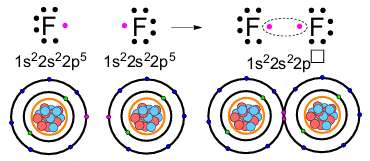
Try solving on your own before revealing the answer!
Final Answer:
Each fluorine atom has 7 valence electrons, as shown by the 7 dots in the electron dot diagram.
Q7. How many more valence electrons does fluorine need to have a full octet?
Background
Topic: Octet Rule
This question is testing your understanding of how many electrons fluorine needs to achieve a stable, full valence shell (octet).
Key Terms:
Octet Rule: Atoms tend to have 8 electrons in their valence shell for stability.
Valence Electrons: Electrons in the outermost shell.
Step-by-Step Guidance
Recall that fluorine has 7 valence electrons.
Determine how many more electrons are needed to reach 8 (the octet).
Think about how fluorine can achieve this by sharing electrons with another atom.
Try solving on your own before revealing the answer!
Final Answer:
Fluorine needs 1 more valence electron to have a full octet.
Q8. Why would two fluorine atoms form a covalent molecule rather than an ionic molecule?
Background
Topic: Covalent Bond Formation
This question is testing your understanding of why two nonmetals (like fluorine) form covalent bonds instead of ionic bonds.
Key Terms:
Covalent Bond: A bond formed by sharing electrons between atoms.
Ionic Bond: A bond formed by transferring electrons from one atom to another.
Step-by-Step Guidance
Recall that both fluorine atoms are nonmetals and have high electronegativity.
Neither atom can easily lose or gain electrons to form ions.
Instead, they share electrons to achieve a full octet.
Think about how sharing electrons allows both atoms to become stable.
Try solving on your own before revealing the answer!
Final Answer:
Two fluorine atoms form a covalent molecule because both are nonmetals and prefer to share electrons to achieve a full octet, rather than transferring electrons.
