 Indietro
GOB Chemistry Exam 1B Study Guidance: Nomenclature, Reactions, Isomers, and Critical Thinking
Guida di studio - Note intelligenti
 Appunti personalizzati basati sui tuoi materiali, ampliati con definizioni chiave, esempi e contesto.
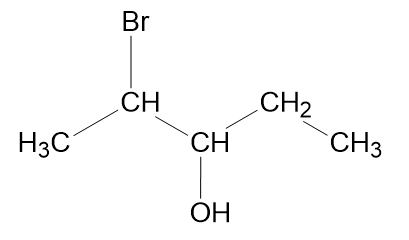
Q21. What is the IUPAC name for the compound below?
Background
Topic: Organic Nomenclature
This question tests your ability to apply IUPAC rules to name organic compounds with multiple substituents, including halogens and alcohols.
Key Terms and Formulas:
IUPAC: International Union of Pure and Applied Chemistry naming system for organic molecules.
Functional groups: Alcohol (-OH), Halide (Br-).
Numbering: Number the carbon chain to give the lowest possible numbers to substituents.
Step-by-Step Guidance
Identify the longest continuous carbon chain in the molecule. This will determine the base name (e.g., pentane, hexane).
Number the chain so that the substituents (Br and OH) get the lowest possible numbers. Alcohol (-OH) usually gets priority in numbering.
Assign the correct locants (numbers) to each substituent and list them in alphabetical order in the name.
Combine the substituent names with the base name, using proper IUPAC format.
Try solving on your own before revealing the answer!
Final Answer: 2-bromo-3-pentanol
The longest chain is pentane. Numbering from the left gives Br at carbon 2 and OH at carbon 3. The IUPAC name is 2-bromo-3-pentanol.
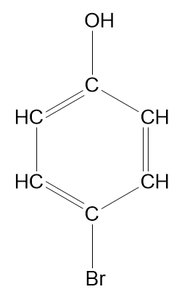
Q22. Give the common and IUPAC names for the following compound.
Background
Topic: Aromatic Compounds Nomenclature
This question tests your ability to name substituted aromatic compounds using both common and IUPAC conventions.
Key Terms and Formulas:
Phenol: Benzene ring with an -OH group.
Bromo: Bromine substituent.
Positions: ortho (2), meta (3), para (4) relative to the -OH group.
Step-by-Step Guidance
Identify the parent compound (phenol).
Determine the position of the bromine relative to the -OH group (number the ring starting at the -OH).
Write the IUPAC name using the correct locant for Br.
Recall the common naming system for substituted phenols (e.g., ortho-, meta-, para-).
Try solving on your own before revealing the answer!
Final Answer: Common name: para-bromophenol; IUPAC name: 4-bromophenol
The bromine is at the para (4) position relative to the -OH group. The common name is para-bromophenol, and the IUPAC name is 4-bromophenol.
Q23. Draw the product of the following reaction:

Background
Topic: Alkene Addition Reactions
This question tests your understanding of electrophilic addition reactions, specifically halogenation of alkenes.
Key Terms and Formulas:
Alkene: Carbon-carbon double bond.
Halogenation: Addition of Br2 across the double bond.
Product: Vicinal dibromide (two Br atoms added to adjacent carbons).
Step-by-Step Guidance
Identify the location of the double bond in the reactant.
Recognize that Br2 will add across the double bond, breaking it and attaching Br atoms to each carbon formerly involved in the double bond.
Draw the resulting structure, showing the two Br atoms on adjacent carbons.
Check that the rest of the carbon chain remains unchanged.
Try solving on your own before revealing the answer!
Final Answer: 2,3-dibromo-3-methylpentane
The double bond is between carbons 2 and 3. After addition, Br atoms are attached to carbons 2 and 3, resulting in 2,3-dibromo-3-methylpentane.
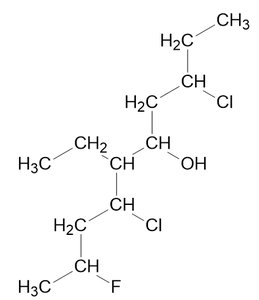
Q24. Draw 4-fluoro-3-ethyl-2-butanol.
Background
Topic: Organic Structure Drawing and Nomenclature
This question tests your ability to interpret IUPAC names and draw the corresponding structure, including correct placement of substituents.
Key Terms and Formulas:
Butanol: Four-carbon chain with an -OH group.
Fluoro: Fluorine substituent.
Ethyl: Two-carbon substituent.
Numbering: Assign numbers to the chain to place substituents correctly.
Step-by-Step Guidance
Draw a four-carbon chain (butane).
Place the -OH group on carbon 2 (2-butanol).
Add an ethyl group to carbon 3.
Add a fluorine atom to carbon 4.
Try solving on your own before revealing the answer!
Final Answer: Structure matches the name 4-fluoro-3-ethyl-2-butanol
The structure shows a four-carbon chain with an -OH on carbon 2, an ethyl group on carbon 3, and a fluorine on carbon 4.
