 Indietro
Introduction to Organic Chemistry: Hydrocarbons (Ch.12 Study Notes)
Guida di studio - Note intelligenti
 Appunti personalizzati basati sui tuoi materiali, ampliati con definizioni chiave, esempi e contesto.
Introduction to Organic Chemistry
Definition and Scope
Organic chemistry is the study of the structure, properties, and reactions of carbon-containing compounds. Organic compounds are characterized by the presence of carbon-carbon (C–C) and carbon-hydrogen (C–H) bonds. Many organic compounds also contain other elements such as oxygen (O), nitrogen (N), sulfur (S), and halogens (F, Cl, Br, I).
Key Point 1: Organic compounds must contain at least one C–C or C–H bond.
Key Point 2: The diversity of organic compounds arises from the ability of carbon to form stable bonds with itself and other elements, leading to a vast array of molecular structures.
Example: Ethanol (C2H6O) and propane (C3H8) are common organic compounds found in nature.
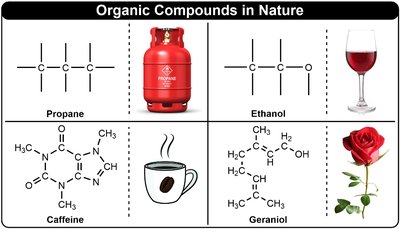
Structural Diversity of Organic Compounds
Chains, Branches, and Rings
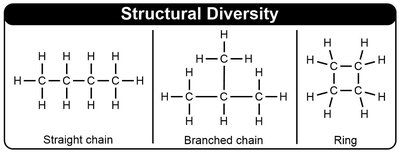
Carbon atoms can bond to each other in various ways, resulting in straight chains, branched chains, and ring structures. This structural diversity is a fundamental aspect of organic chemistry.
Key Point 1: Straight-chain alkanes have all carbon atoms connected in a single, unbranched line.
Key Point 2: Branched-chain alkanes have one or more carbon atoms connected to three or four other carbons, creating branches.
Key Point 3: Ring structures (cyclic compounds) occur when carbon chains close to form a loop.
Example: Butane (C4H10) can exist as a straight chain or as a branched isomer (isobutane).
Molecular and Structural Formulas
Molecular Formula
The molecular formula indicates the number and type of atoms in a molecule but does not show how the atoms are connected.
Key Point 1: Molecular formulas are useful for determining the composition of a compound but not its structure.
Example: C2H6O could represent either ethanol or dimethyl ether.
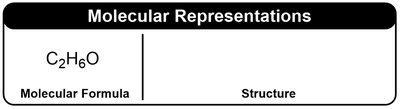
Structural Formula
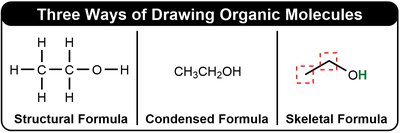
The structural formula shows how atoms are connected in a molecule, providing information about the arrangement of bonds.
Key Point 1: Structural formulas are essential for understanding the connectivity and geometry of organic molecules.
Example: The structural formula for propane (C3H8) is shown below.
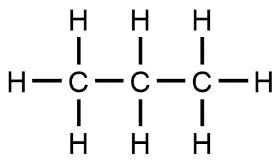
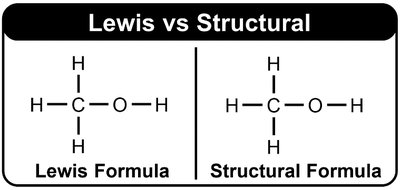
Lewis vs Structural Formula
Lewis structures show all atoms, bonds, and lone pairs, while structural formulas typically omit lone pairs for simplicity.
Key Point 1: Both representations are useful, but structural formulas are more common in organic chemistry for clarity and brevity.
Condensed and Skeletal Formulas
Condensed Formula
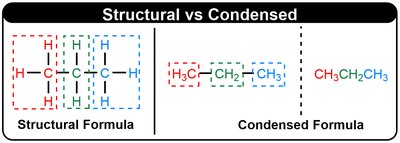
Condensed formulas group atoms together to simplify the representation of organic molecules, especially for larger compounds.
Key Point 1: Atoms bonded to a central atom are written together, e.g., CH3CH2CH3 for propane.
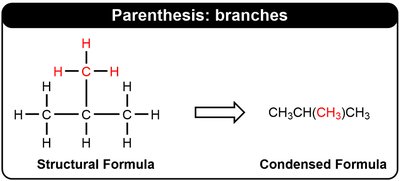
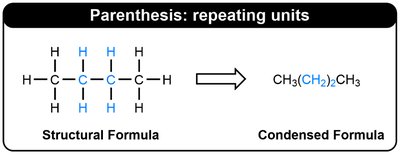
Key Point 2: Parentheses indicate branches or repeating units, e.g., CH3CH(CH3)CH3 for isobutane.
Skeletal Formula
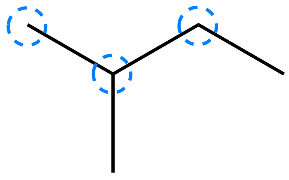
Skeletal formulas are the most simplified way to represent organic molecules, showing only the carbon skeleton and heteroatoms. Each vertex or line end represents a carbon atom, and hydrogen atoms attached to carbons are usually omitted.
Key Point 1: Useful for complex molecules and for quickly visualizing the carbon framework.
Key Point 2: Heteroatoms (e.g., O, N, Cl) are always shown explicitly.
Classification of Hydrocarbons
Types of Hydrocarbons
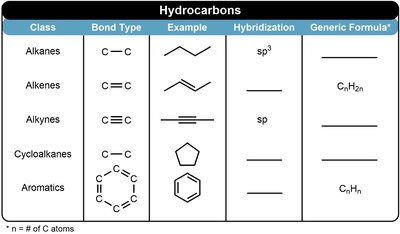
Hydrocarbons are organic compounds composed solely of carbon and hydrogen. They are classified based on the types of bonds between carbon atoms.
Alkanes: Only single bonds (C–C); saturated hydrocarbons.
Alkenes: At least one double bond (C=C); unsaturated hydrocarbons.
Alkynes: At least one triple bond (C≡C); unsaturated hydrocarbons.
Cycloalkanes: Ring structures with only single bonds.
Aromatics: Contain conjugated ring systems, such as benzene.
Saturated vs Unsaturated Hydrocarbons
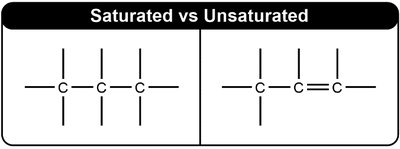
Saturated hydrocarbons contain only single bonds, while unsaturated hydrocarbons contain one or more double or triple bonds.
Key Point 1: Saturated hydrocarbons have the maximum number of hydrogen atoms per carbon.
Key Point 2: Unsaturated hydrocarbons have fewer hydrogens due to the presence of multiple bonds.
Isomerism in Organic Compounds
Types of Isomers
Isomers are compounds with the same molecular formula but different structures or spatial arrangements.
Structural (Constitutional) Isomers: Same molecular formula, different connectivity of atoms.
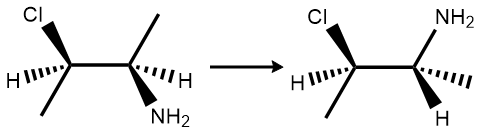
Stereoisomers: Same molecular formula and connectivity, different spatial orientation.
Geometric (cis/trans) Isomers: Differ in arrangement around a double bond.
Optical Isomers: Non-superimposable mirror images (enantiomers).

Bond Rotation and Spatial Orientation
Rotation vs Orientation
Single bonds (sigma bonds) in alkanes allow free rotation, while double bonds (pi bonds) in alkenes restrict rotation, leading to geometric isomerism.
Key Point 1: Free rotation around single bonds allows for different conformations.
Key Point 2: Restricted rotation around double bonds creates distinct cis and trans isomers.
Naming Organic Compounds
IUPAC Nomenclature
The International Union of Pure and Applied Chemistry (IUPAC) provides systematic rules for naming organic compounds. The name reflects the structure, including the length of the carbon chain, the presence of branches or rings, and the types and positions of functional groups.
Key Point 1: The parent chain is the longest continuous chain of carbon atoms.
Key Point 2: Substituents are named and numbered to give the lowest possible numbers to the branches or functional groups.
Key Point 3: Prefixes (di-, tri-, tetra-) are used for multiple identical substituents.
Alkane Prefixes
Alkane names are based on the number of carbon atoms and end with the suffix -ane (e.g., methane, ethane, propane).
Naming Alkanes with Substituents
When alkanes have branches (alkyl groups), the name includes the location and name of each substituent, listed in alphabetical order.
Naming Cycloalkanes
Cyclic alkanes are named by adding the prefix 'cyclo-' to the alkane name. Substituents are numbered to give the lowest possible numbers.
Naming Alkenes and Alkynes
Alkenes and alkynes are named by modifying the -ane ending to -ene (for double bonds) or -yne (for triple bonds). The position of the multiple bond is indicated by a number.
Naming Benzene Derivatives
Benzene derivatives are named based on the number and position of substituents. Common names (e.g., toluene, xylene) are sometimes used for monosubstituted and disubstituted benzenes.
Reactions of Hydrocarbons
Alkane Reactions
Alkanes are relatively unreactive but undergo combustion and halogenation reactions.
Combustion: Reaction with O2 to produce CO2 and H2O.
Halogenation: Substitution of H by Cl or Br in the presence of heat or light.
Addition Reactions of Alkenes and Alkynes
Alkenes and alkynes undergo addition reactions, where atoms are added to the carbons of the multiple bond, converting double or triple bonds to single bonds.
Halogenation: Addition of X2 (Cl2 or Br2).
Hydrogenation: Addition of H2 in the presence of a catalyst.
Hydration: Addition of H2O (acid-catalyzed) to form alcohols, following Markovnikov's rule.
Summary Table: Hydrocarbon Classes
Class | Bond Type | Example | Hybridization | Generic Formula |
|---|---|---|---|---|
Alkanes | C–C | Ethane | sp3 | CnH2n+2 |
Alkenes | C=C | Ethene | sp2 | CnH2n |
Alkynes | C≡C | Ethyne | sp | CnH2n-2 |
Cycloalkanes | C–C (ring) | Cyclohexane | sp3 | CnH2n |
Aromatics | Conjugated ring | Benzene | sp2 | CnHn |
Key Equations
Combustion of Alkane:
General Formula for Alkanes:
General Formula for Alkenes:
General Formula for Alkynes:
Additional info: This summary covers the foundational concepts of organic chemistry, focusing on hydrocarbons, their classification, structural diversity, isomerism, and basic nomenclature and reactions, as outlined in a typical GOB Chemistry curriculum.
