 Indietro
Thermochemistry: Energy, Enthalpy, and Calorimetry
Guida di studio - Note intelligenti
 Appunti personalizzati basati sui tuoi materiali, ampliati con definizioni chiave, esempi e contesto.
Thermochemistry
The Nature of Energy
Thermochemistry is the study of energy changes, particularly heat, that accompany chemical reactions and physical changes. Energy is defined as the ability to do work or transfer heat. In chemical systems, energy is transferred as heat or work.
SI unit of energy: joule (J), where
Common units: kilojoule (kJ), calorie (cal), nutritional Calorie (Cal)
Conversion: ,
Types of Energy
Energy in objects and molecules exists as kinetic energy (KE) and potential energy (PE).
Kinetic Energy (KE): Energy due to motion.
Potential Energy (PE): Energy due to position or composition. Includes electrostatic and nuclear potential energy.
Kinetic Energy in Molecules
Translation: Straight-line motion, most important in gases.
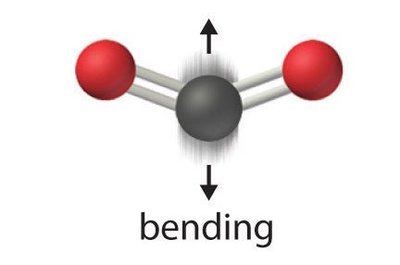
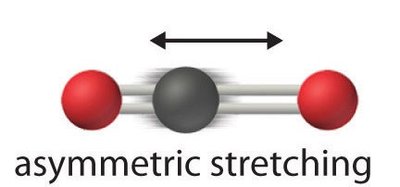
Vibration: Oscillation of atoms within molecules, present in all states.
Rotation: Rotation around molecular axes, significant in gases and liquids.
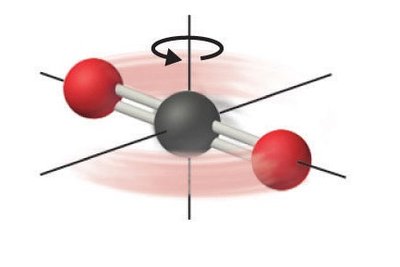
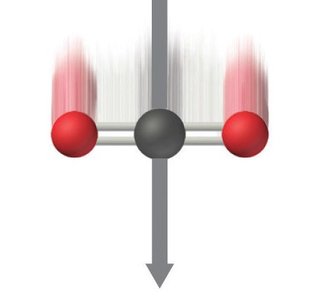
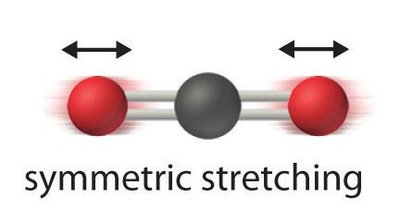
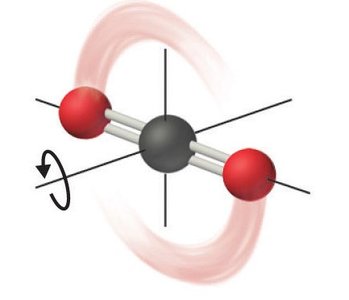
Temperature and Kinetic Energy
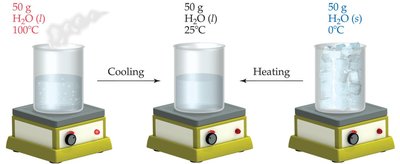
Temperature is a measure of the average kinetic energy of the particles in a system. It is an intensive property (does not depend on amount), while heat is an extensive property (depends on amount).
Potential Energy in Chemistry
Electrostatic Potential Energy: Due to interactions between charged particles (e.g., ions, electrons, nuclei).
Nuclear Potential Energy: Due to attractions between protons and neutrons in the nucleus.
Law of Conservation of Energy (First Law of Thermodynamics)
Energy cannot be created or destroyed; it can only be transformed from one form to another. The total energy of the universe is constant.
System and Surroundings
Definitions
System: The part of the universe under study.
Surroundings: Everything outside the system.
Universe: System + surroundings
Types of Systems
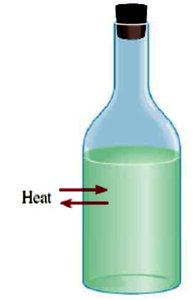
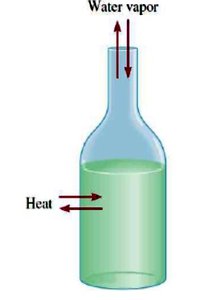
Open System: Exchanges both energy and matter with surroundings.
Closed System: Exchanges energy but not matter with surroundings.
Isolated System: Exchanges neither energy nor matter with surroundings.

Examples
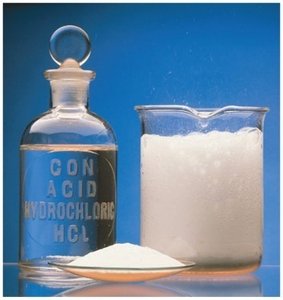
Open: Reaction in an open beaker (CO2 escapes)
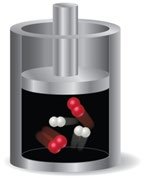
Closed: Reaction in a cylinder with a movable piston
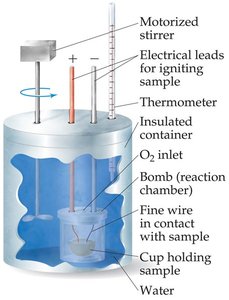
Isolated: Bomb calorimeter or thermos flask

Internal Energy (U)
Definition and Factors
Internal energy (U) is the sum of all kinetic and potential energies of the components of a system. It depends on:
Type of substance
Amount of substance
Temperature
Phase (solid, liquid, gas)
Change in Internal Energy (ΔU)
ΔU = Ufinal - Uinitial
Measured in kJ mol-1
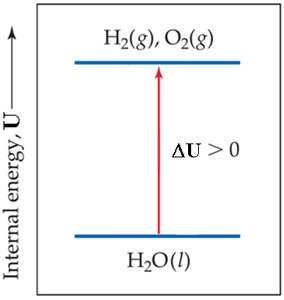
ΔU > 0: System absorbs energy (endothermic)
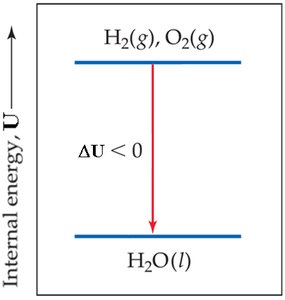
ΔU < 0: System releases energy (exothermic)
Heat (q), Work (w), and Internal Energy
Energy is exchanged as heat (q) and/or work (w):
Heat added to system: +q; heat lost: -q
Work done on system: +w; work done by system: -w
Sign Conventions
Negative values: Energy lost by system
Positive values: Energy gained by system
Work and Heat Calculations
Work:
Pressure-volume work:
State Functions
A state function depends only on the state of the system, not on the path taken. Internal energy (U) is a state function, but heat (q) and work (w) are not.
Enthalpy (H)
Definition
Enthalpy (H) is the energy absorbed or released during a reaction at constant pressure. It is defined as:
Change in enthalpy:
At constant pressure: (heat at constant pressure)
Endothermic and Exothermic Processes
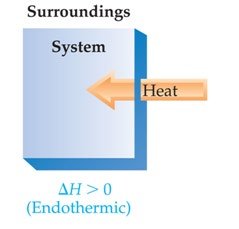
Endothermic: System absorbs heat,
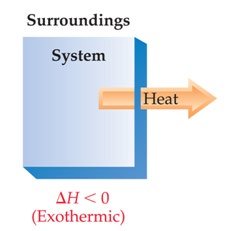
Exothermic: System releases heat,
Enthalpy of Reaction (ΔHrxn)
ΔH is extensive (depends on amount of substance)
ΔH for reverse reaction is equal in magnitude, opposite in sign
ΔH depends on the physical state of reactants and products
Hess's Law
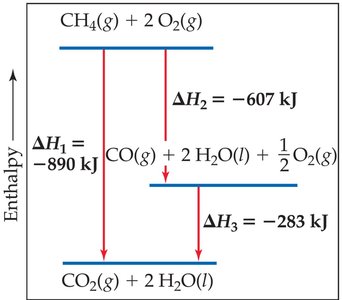
If a reaction occurs in steps, the overall enthalpy change is the sum of the enthalpy changes for each step:
Standard Enthalpy of Formation (ΔHf°)
ΔHf°: Enthalpy change for formation of 1 mole of a compound from its elements in their standard states
Standard state: 25°C, 1 bar (or 1 atm), pure substances, 1 M solutions
Reference form: Most stable physical form of an element at standard conditions (e.g., O2(g), C(s, graphite))
Calculating ΔH°rxn from ΔH°f
n, m: Stoichiometric coefficients from balanced equation
Heat Capacity and Calorimetry
Heat Capacity (C)
Amount of heat required to raise temperature of a substance by 1°C or 1 K
Units: J°C-1 or J K-1
Specific Heat (Cs) and Molar Heat Capacity (Cm)
Specific heat (Cs): Heat required to raise temperature of 1 g by 1 K (J g-1 K-1)
Molar heat capacity (Cm): Heat required to raise temperature of 1 mol by 1 K (J mol-1 K-1)
Calorimetry
Calorimetry is the measurement of heat flow based on temperature changes. Two main types of calorimeters are used:
Coffee-cup calorimeter: Measures heat at constant pressure (qp = ΔH)
Bomb calorimeter: Measures heat at constant volume (qv = ΔU)
Example Calculations
For coffee-cup calorimeter:
For bomb calorimeter:
Summary Table: Types of Systems
System Type | Energy Exchange | Matter Exchange | Example |
|---|---|---|---|
Open | Yes | Yes | Open beaker reaction |
Closed | Yes | No | Reaction in piston |
Isolated | No | No | Bomb calorimeter |
