 Indietro
Units, Measurements, and Significant Figures in Chemistry
Guida di studio - Note intelligenti
 Appunti personalizzati basati sui tuoi materiali, ampliati con definizioni chiave, esempi e contesto.
Units of Measurement
Metric and SI Units
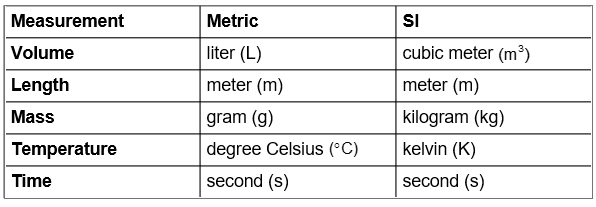
The metric system and the International System of Units (SI) are the standard systems used by scientists worldwide for measurement. Each system defines units for fundamental quantities such as volume, length, mass, temperature, and time.
Metric System: Commonly used in everyday life and science.
SI System: The official scientific standard, often used in research and international communication.
Key Units:
Measurement | Metric | SI |
|---|---|---|
Volume | liter (L) | cubic meter (m3) |
Length | meter (m) | meter (m) |
Mass | gram (g) | kilogram (kg) |
Temperature | degree Celsius (°C) | kelvin (K) |
Time | second (s) | second (s) |
Measured Numbers and Significant Figures
Understanding Measured Numbers
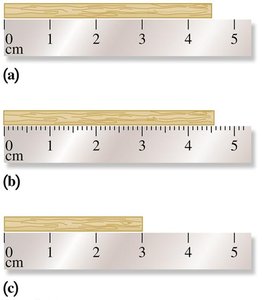
Measured numbers are obtained by physically measuring a quantity, such as length, mass, or temperature. The value includes all certain digits plus one estimated digit, which reflects the precision of the measurement.
Observation: Read the value at the marked lines.
Estimation: Estimate the value between the marks for the final digit.
Example: Measuring Length
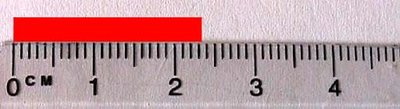
The length of the red line is determined by reading the ruler and estimating the last digit.
Significant Figures (SFs)
Significant figures are the digits in a measured number that represent meaningful information, including the estimated digit. They indicate the precision and reliability of the measurement.
All nonzero digits are significant.
Zeros between nonzero digits are significant.
Zeros at the end of a decimal number are significant.
Leading zeros (before nonzero digits) are not significant.
Zeros in large numbers without a decimal point are not significant.
Coefficients in scientific notation are significant.
Rules for Identifying Significant Figures
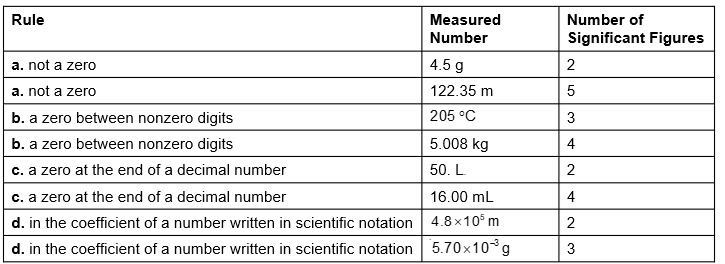
Rule | Measured Number | Number of Significant Figures |
|---|---|---|
a. not a zero | 4.5 g | 2 |
a. not a zero | 122.35 m | 5 |
b. a zero between nonzero digits | 205 °C | 3 |
b. a zero between nonzero digits | 5.008 kg | 4 |
c. a zero at the end of a decimal number | 50. L | 2 |
c. a zero at the end of a decimal number | 16.00 mL | 4 |
d. in the coefficient of a number written in scientific notation | 4.8 × 10⁵ m | 2 |
d. in the coefficient of a number written in scientific notation | 5.70 × 10⁻³ g | 3 |
Non-Significant Zeros
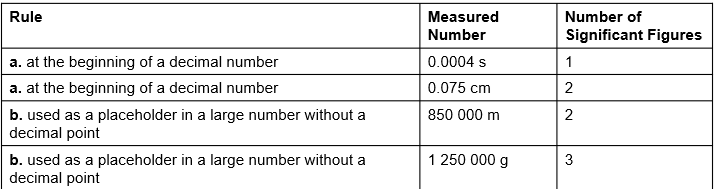
Rule | Measured Number | Number of Significant Figures |
|---|---|---|
a. at the beginning of a decimal number | 0.0004 s | 1 |
a. at the beginning of a decimal number | 0.075 cm | 2 |
b. used as a placeholder in a large number without a decimal point | 850 000 m | 2 |
b. used as a placeholder in a large number without a decimal point | 1 250 000 g | 3 |
Exact Numbers
Definition and Examples
Exact numbers are values obtained by counting or defined relationships, not by measurement. They have an infinite number of significant figures and do not limit the precision of calculated answers.
Counting: e.g., 8 cookies
Defined quantities: e.g., 1 dozen = 12 eggs, 1 kg = 1000 g
Rounding and Calculations with Significant Figures
Rules for Rounding
When rounding numbers, follow these rules:
If the first digit to be dropped is 4 or less, drop it and all following digits.
If the first digit to be dropped is 5 or greater, increase the last retained digit by 1.
Number to Round Off | Three Significant Figures | Two Significant Figures |
|---|---|---|
8.4234 | 8.42 (drop 34) | 8.4 (drop 234) |
14.780 | 14.8 (drop 80, increase last retained digit by 1) | 15 (drop 780, increase last retained digit by 1) |
3256 | 3260 (drop 6, increase last retained digit by 1, add 0) (3.26 × 10³) | 3300 (drop 56, increase last retained digit by 1, add 00) (3.3 × 10³) |

Multiplication and Division
When multiplying or dividing measured numbers, the final answer should have the same number of significant figures as the measurement with the fewest significant figures.
Example: (Calculator gives 3, but answer should be 3.0 to match the number of significant figures in the input.)

Addition and Subtraction
For addition and subtraction, the final answer should have the same number of decimal places as the measurement with the fewest decimal places.
Metric Prefixes and Equalities
SI Prefix Multipliers
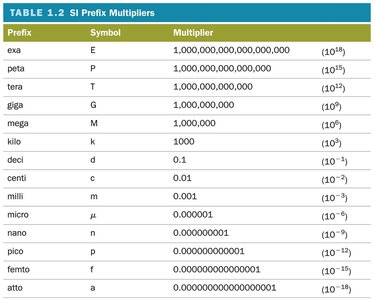
Prefixes are used in the metric system to indicate multiples or fractions of units. They are essential for expressing measurements in appropriate scales.
Prefix | Symbol | Multiplier |
|---|---|---|
kilo | k | 1000 (103) |
centi | c | 0.01 (10-2) |
milli | m | 0.001 (10-3) |
micro | μ | 0.000001 (10-6) |
nano | n | 0.000000001 (10-9) |
Examples of Metric Equalities
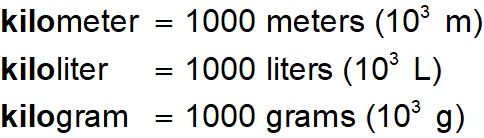
Kilometer: 1 km = 1000 m ()
Kilogram: 1 kg = 1000 g ()
Kiloliter: 1 kL = 1000 L ()
Conversion Factors and Problem Solving
Using Conversion Factors
Conversion factors are ratios used to convert from one unit to another. They are derived from equalities and are essential for solving chemistry problems.
Example: To convert 85 kg to pounds, use .
Percentage, ppm, ppb: Used for very small ratios, such as concentration of substances.
Equality | Conversion Factors | Significant Figures or Exact |
|---|---|---|
100 kg of body mass = 18 kg of body fat | \frac{18\ \text{kg body fat}}{100\ \text{kg body mass}} and \frac{100\ \text{kg body mass}}{18\ \text{kg body fat}} | 18 kg is measured (2 SFs), 100 kg is exact |

Density
Definition and Calculation
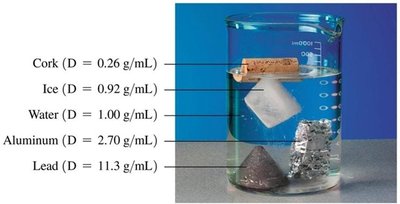
Density is a physical property that compares the mass of an object to its volume. It is used to identify substances and predict whether objects will float or sink in water.
Formula:
Units: g/mL or g/cm3
Objects with density greater than water (1.00 g/mL) sink; those with lower density float.
Density of Solids
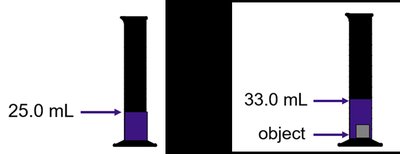
The density of a solid can be determined by measuring its mass and volume, often using volume displacement in a graduated cylinder.
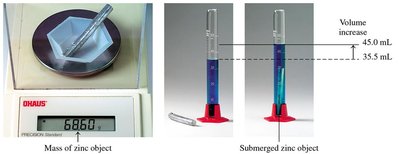
Example Calculation
Given: Mass = 48.0 g; Volume (from displacement) = 33.0 . mL - 25.0 mL = 8.0 mL
Density:
Summary Table: Key Concepts
Metric and SI units are used for scientific measurements.
Significant figures reflect the precision of measured numbers.
Exact numbers are counted or defined and have infinite .. substances.
