Ch.10 Proteins Workers of the Cell
Frost - General, Organic and Biological Chemistry 4th Edition
Frost4th EditionGeneral, Organic and Biological ChemistryISBN: 9780134988696Non è quello che usi tu?Cambia libro di testo
Capitolo 6, Problema 2

Classify each of the amino acids in Problem 10.1 as polar (neutral, acidic, or basic) or nonpolar and as hydrophobic or hydrophilic.
a. alanine
b. lysine
c. tryptophan
d. aspartate

Guida verificata passo dopo passo
1
Step 1: Review the structure of each amino acid provided in Problem 10.1. Identify the functional groups present in the side chain (R group) of each amino acid.
Step 2: Determine the polarity of the amino acid based on the nature of its side chain. If the side chain contains polar groups (e.g., hydroxyl, amine, carboxyl), classify it as polar. If the side chain is primarily hydrocarbon-based, classify it as nonpolar.
Step 3: Further classify polar amino acids into neutral, acidic, or basic categories. Neutral polar amino acids have uncharged polar side chains, acidic amino acids have negatively charged side chains (e.g., carboxylate groups), and basic amino acids have positively charged side chains (e.g., amine groups).
Step 4: Assess whether the amino acid is hydrophobic or hydrophilic. Nonpolar amino acids are typically hydrophobic because they do not interact well with water, while polar amino acids are hydrophilic due to their ability to form hydrogen bonds with water.
Step 5: Summarize the classification for each amino acid in Problem 10.1, listing its polarity (nonpolar or polar, and if polar, whether neutral, acidic, or basic) and its hydrophobic or hydrophilic nature.

Risposta video verificata per un problema simile:

Questa soluzione video è stata consigliata dai nostri tutor come utile per risolvere questo problema.
Durata del video:
4m

Concetti chiave

Ecco i concetti essenziali che devi comprendere per rispondere correttamente alla domanda.

Amino Acid Classification

Amino acids can be classified based on the properties of their side chains (R groups). They are categorized as polar or nonpolar, with polar amino acids having side chains that can form hydrogen bonds with water, making them hydrophilic, while nonpolar amino acids have hydrophobic side chains that do not interact favorably with water.
Video consigliato:
Percorso guidato
1:33
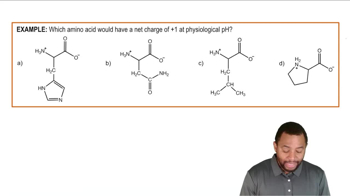
Amino Acid Classifications Example 3

Hydrophobic vs. Hydrophilic

Hydrophobic amino acids tend to avoid water and are typically found in the interior of proteins, contributing to the protein's overall structure. In contrast, hydrophilic amino acids interact well with water and are often located on the surface of proteins, facilitating interactions with the aqueous environment.
Video consigliato:
Percorso guidato
3:33
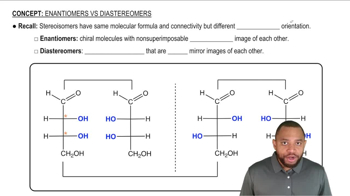
Enantiomers vs Diastereomers Concept 1

Acidic and Basic Amino Acids

Acidic amino acids possess side chains that can donate protons (H+), making them negatively charged at physiological pH, while basic amino acids have side chains that can accept protons, resulting in a positive charge. This charge affects their interactions and roles in protein structure and function.
Video consigliato:
Percorso guidato
1:33
Amino Acid Classifications Example 3