Ch.10 Proteins Workers of the Cell
Frost - General, Organic and Biological Chemistry 4th Edition
Frost4th EditionGeneral, Organic and Biological ChemistryISBN: 9780134988696Non è quello che usi tu?Cambia libro di testo
Capitolo 6, Problema 64

Draw the structure of the possible dipeptides formed from one alanine combining with one cysteine.

Guida verificata passo dopo passo
1
Identify the amino acids involved: Alanine (Ala) and Cysteine (Cys).
Understand that a dipeptide is formed by a peptide bond between the carboxyl group of one amino acid and the amino group of another.
Consider the two possible combinations: Alanine can be the N-terminal (first) or the C-terminal (second) amino acid.
For the first dipeptide, form a peptide bond between the carboxyl group of Alanine and the amino group of Cysteine, resulting in Ala-Cys.
For the second dipeptide, form a peptide bond between the carboxyl group of Cysteine and the amino group of Alanine, resulting in Cys-Ala.

Risposta video verificata per un problema simile:

Questa soluzione video è stata consigliata dai nostri tutor come utile per risolvere questo problema.
Durata del video:
5m

Concetti chiave

Ecco i concetti essenziali che devi comprendere per rispondere correttamente alla domanda.

Amino Acids

Amino acids are organic compounds that serve as the building blocks of proteins. Each amino acid has a central carbon atom, an amino group, a carboxyl group, a hydrogen atom, and a variable side chain (R group) that determines its unique properties. In this case, alanine and cysteine are two specific amino acids, each with distinct side chains that influence the characteristics of the resulting dipeptide.
Video consigliato:
Percorso guidato
3:03
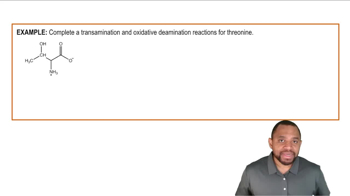
Amino Acid Catabolism: Amino Group Example 2

Dipeptide Formation

A dipeptide is formed when two amino acids undergo a condensation reaction, resulting in the release of a water molecule. This process involves the carboxyl group of one amino acid reacting with the amino group of another, creating a peptide bond. Understanding this reaction is crucial for drawing the correct structure of the dipeptide formed from alanine and cysteine.
Video consigliato:
Percorso guidato
1:41
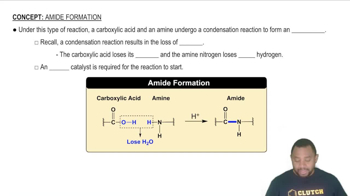
Amide Formation Concept 1

Peptide Bond

A peptide bond is a covalent bond that links two amino acids together in a protein or peptide chain. It is formed through a dehydration synthesis reaction, where the carboxyl group of one amino acid reacts with the amino group of another, releasing water. Recognizing the nature of peptide bonds is essential for accurately depicting the structure of dipeptides, including the specific bond formed between alanine and cysteine.
Video consigliato:
Percorso guidato
1:24
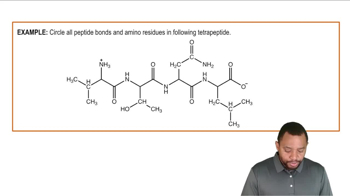
Peptides Example 1