Ch.10 Proteins Workers of the Cell
Frost - General, Organic and Biological Chemistry 4th Edition
Frost4th EditionGeneral, Organic and Biological ChemistryISBN: 9780134988696Non è quello che usi tu?Cambia libro di testo
Capitolo 6, Problema 68

Name the covalent bond that helps to stabilize the tertiary structure of a protein.

Guida verificata passo dopo passo
1
Understand that the tertiary structure of a protein refers to the three-dimensional folding of the protein chain, which is stabilized by various interactions and bonds.
Recall that covalent bonds are strong chemical bonds formed by the sharing of electron pairs between atoms.
Identify the specific covalent bond that stabilizes the tertiary structure of proteins: the disulfide bond (also called a disulfide bridge).
Explain that disulfide bonds form between the sulfur atoms of two cysteine amino acid residues in the protein, creating a covalent linkage (S-S bond).
Conclude that disulfide bonds are crucial for maintaining the stability and proper folding of the protein's tertiary structure, especially in extracellular proteins.

Risposta video verificata per un problema simile:

Questa soluzione video è stata consigliata dai nostri tutor come utile per risolvere questo problema.
Durata del video:
2m

Concetti chiave

Ecco i concetti essenziali che devi comprendere per rispondere correttamente alla domanda.

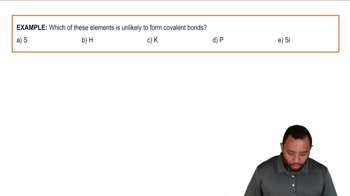
Covalent Bonds

Covalent bonds are strong chemical bonds formed when two atoms share electrons. In proteins, these bonds are crucial for maintaining structural integrity. The most relevant covalent bond in the context of protein structure is the disulfide bond, which forms between the sulfur atoms of cysteine residues, providing stability to the protein's tertiary structure.
Video consigliato:
Percorso guidato
01:04
Covalent Bonds Example 1

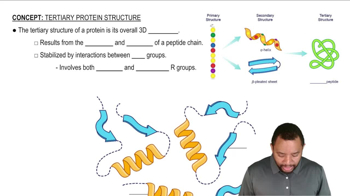
Tertiary Structure of Proteins

The tertiary structure of a protein refers to its three-dimensional shape, which is essential for its function. This structure is formed by the folding and interactions of the protein's secondary structures (like alpha helices and beta sheets) and is stabilized by various interactions, including hydrogen bonds, ionic bonds, and covalent bonds such as disulfide bridges.
Video consigliato:
Percorso guidato
2:07
Tertiary Protein Structure Concept 1

Disulfide Bonds

Disulfide bonds are a specific type of covalent bond that occurs between the thiol groups of cysteine residues in proteins. These bonds play a critical role in stabilizing the tertiary structure by linking different parts of the protein chain, thus helping to maintain its functional conformation under varying environmental conditions.
Video consigliato: