Ch.10 Proteins Workers of the Cell
Frost - General, Organic and Biological Chemistry 4th Edition
Frost4th EditionGeneral, Organic and Biological ChemistryISBN: 9780134988696Non è quello che usi tu?Cambia libro di testo
Capitolo 6, Problema 54a

Indicate whether each of the following describes a competitive or a noncompetitive inhibitor.
a. The structure of the inhibitor is similar to that of the substrate.

Guida verificata passo dopo passo
1
Understand the difference between competitive and noncompetitive inhibitors: A competitive inhibitor competes with the substrate for binding to the active site of the enzyme because its structure is similar to the substrate. A noncompetitive inhibitor binds to a different site on the enzyme (not the active site) and changes the enzyme's shape, reducing its activity regardless of substrate binding.
Analyze the statement: 'The structure of the inhibitor is similar to that of the substrate.'
Recognize that if the inhibitor's structure is similar to the substrate, it is likely to compete with the substrate for the active site of the enzyme.
Conclude that this description aligns with the characteristics of a competitive inhibitor.
Label the inhibitor described in the problem as a competitive inhibitor based on the reasoning above.

Risposta video verificata per un problema simile:

Questa soluzione video è stata consigliata dai nostri tutor come utile per risolvere questo problema.
Durata del video:
3m

Concetti chiave

Ecco i concetti essenziali che devi comprendere per rispondere correttamente alla domanda.

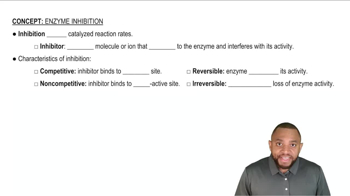
Competitive Inhibition

Competitive inhibition occurs when an inhibitor molecule resembles the substrate and competes for binding to the active site of an enzyme. This type of inhibition can be overcome by increasing the concentration of the substrate, as more substrate molecules can outcompete the inhibitor for the active site.
Video consigliato:
Percorso guidato
1:19
Enzyme Inhibition Concept 1

Noncompetitive Inhibition

Noncompetitive inhibition happens when an inhibitor binds to an enzyme at a site other than the active site, altering the enzyme's function regardless of substrate concentration. This means that increasing substrate levels does not affect the inhibitor's ability to reduce the enzyme's activity, as the inhibitor can bind to both the enzyme and the enzyme-substrate complex.
Video consigliato:
Percorso guidato
1:19
Enzyme Inhibition Concept 1

Enzyme-Substrate Complex

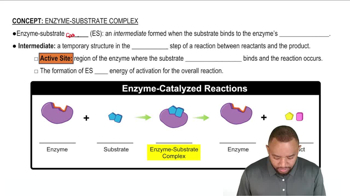
The enzyme-substrate complex is formed when a substrate molecule binds to the active site of an enzyme, facilitating the chemical reaction. Understanding this complex is crucial for distinguishing between competitive and noncompetitive inhibition, as the binding dynamics directly influence enzyme activity and reaction rates.
Video consigliato:
Percorso guidato
2:32
Enzyme-Substrate Complex Concept 1