Ch.11 Nucleic Acids Big Molecules with a Big Role
Frost - General, Organic and Biological Chemistry 4th Edition
Frost4th EditionGeneral, Organic and Biological ChemistryISBN: 9780134988696Non è quello che usi tu?Cambia libro di testo
Capitolo 7, Problema 55b

Identify each of the following bases as a pyrimidine or a purine:
b. adenine

Guida verificata passo dopo passo
1
Understand the difference between purines and pyrimidines: Purines are larger, double-ring structures, while pyrimidines are smaller, single-ring structures. This distinction is key to identifying the type of base.
Recall the specific bases that belong to each category: Purines include adenine (A) and guanine (G), while pyrimidines include cytosine (C), thymine (T), and uracil (U).
Examine the base in question, adenine, and determine its structure. Adenine is a double-ring structure, which is characteristic of purines.
Match adenine to the purine category based on its structural features and the list of purine bases.
Conclude that adenine is a purine because it fits the criteria of being a double-ring structure and is listed as one of the purine bases.

Risposta video verificata per un problema simile:

Questa soluzione video è stata consigliata dai nostri tutor come utile per risolvere questo problema.
Durata del video:
2m

Concetti chiave

Ecco i concetti essenziali che devi comprendere per rispondere correttamente alla domanda.

Pyrimidines and Purines

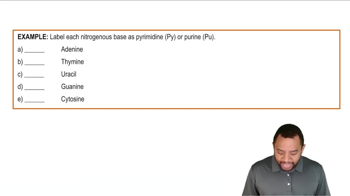
Pyrimidines and purines are the two categories of nitrogenous bases found in nucleic acids. Pyrimidines, which include cytosine, thymine, and uracil, have a single six-membered ring structure. In contrast, purines, such as adenine and guanine, consist of a fused double-ring structure. Understanding the structural differences between these bases is essential for classifying them correctly.
Video consigliato:
Percorso guidato
1:09
Nitrogenous Bases Example 1

Adenine

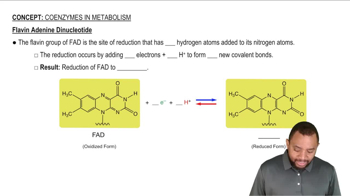
Adenine is one of the two purine bases found in DNA and RNA. It plays a crucial role in cellular processes, including energy transfer as part of ATP (adenosine triphosphate) and in the formation of nucleotides. Recognizing adenine as a purine is important for understanding its function in genetic coding and metabolism.
Video consigliato:
Percorso guidato
1:05
Flavin Adenine Dinucleotide Concept 3

Nucleic Acids

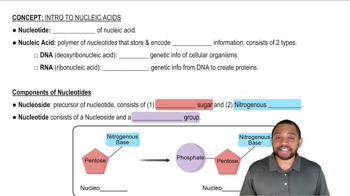
Nucleic acids, such as DNA and RNA, are polymers made up of nucleotide monomers, which include a sugar, a phosphate group, and a nitrogenous base. The sequence of these bases encodes genetic information. Identifying the types of bases (pyrimidines vs. purines) is fundamental to understanding the structure and function of nucleic acids in biological systems.
Video consigliato:
Percorso guidato
1:55
Intro to Nucleic Acids Concept 1