Ch.11 Nucleic Acids Big Molecules with a Big Role
Frost - General, Organic and Biological Chemistry 4th Edition
Frost4th EditionGeneral, Organic and Biological ChemistryISBN: 9780134988696Non è quello che usi tu?Cambia libro di testo
Capitolo 7, Problema 57c

Identify the base and sugar in each of the following nucleotides:
c. dGMP

Guida verificata passo dopo passo
1
Step 1: Understand the structure of a nucleotide. A nucleotide consists of three components: a nitrogenous base, a sugar, and a phosphate group. In this problem, we are focusing on identifying the base and sugar.
Step 2: Analyze the given nucleotide, dGMP. The 'd' in dGMP stands for 'deoxy,' indicating that the sugar is deoxyribose, which is found in DNA nucleotides.
Step 3: Identify the nitrogenous base. The 'G' in dGMP refers to guanine, which is one of the purine bases in nucleotides.
Step 4: Combine the information. The sugar in dGMP is deoxyribose, and the nitrogenous base is guanine.
Step 5: Confirm your understanding by recalling that dGMP stands for deoxyguanosine monophosphate, where 'deoxyguanosine' refers to the combination of deoxyribose and guanine, and 'monophosphate' indicates the presence of one phosphate group.

Risposta video verificata per un problema simile:

Questa soluzione video è stata consigliata dai nostri tutor come utile per risolvere questo problema.
Durata del video:
2m

Concetti chiave

Ecco i concetti essenziali che devi comprendere per rispondere correttamente alla domanda.

Nucleotides

Nucleotides are the building blocks of nucleic acids, such as DNA and RNA. Each nucleotide consists of three components: a nitrogenous base, a five-carbon sugar, and one or more phosphate groups. The nitrogenous base can be classified as purines or pyrimidines, while the sugar can be either ribose (in RNA) or deoxyribose (in DNA). Understanding the structure of nucleotides is essential for analyzing their roles in genetic information storage and transfer.
Video consigliato:
Percorso guidato
1:21
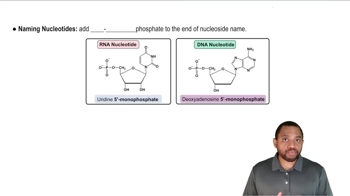
Naming Nucleosides and Nucleotides Concept 2

Nitrogenous Bases

Nitrogenous bases are organic molecules that contain nitrogen and are a key component of nucleotides. In the context of DNA, the main nitrogenous bases are adenine (A), guanine (G), cytosine (C), and thymine (T). In RNA, uracil (U) replaces thymine. Each base pairs specifically with another (A with T, and G with C in DNA) to form the rungs of the DNA ladder, which is crucial for the double helix structure and genetic coding.
Video consigliato:
Percorso guidato
1:23
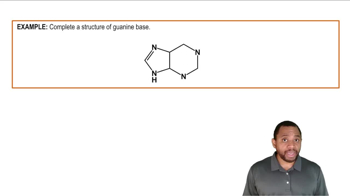
Nitrogenous Bases Example 3

Sugars in Nucleotides

The sugar component of nucleotides is a five-carbon sugar that plays a vital role in the structure of nucleic acids. In DNA, the sugar is deoxyribose, which lacks one oxygen atom compared to ribose, the sugar found in RNA. The sugar connects to the nitrogenous base and the phosphate group, forming the backbone of the nucleic acid strand. Recognizing the type of sugar is important for distinguishing between DNA and RNA nucleotides.
Video consigliato:
Percorso guidato
1:45
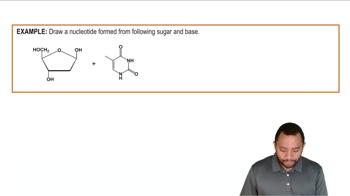
Nucleoside and Nucleotide Formation Example 1