Ch.4 Introduction to Organic Compounds
Frost - General, Organic and Biological Chemistry 4th Edition
Frost4th EditionGeneral, Organic and Biological ChemistryISBN: 9780134988696Non è quello che usi tu?Cambia libro di testo
Capitolo 1, Problema 39c

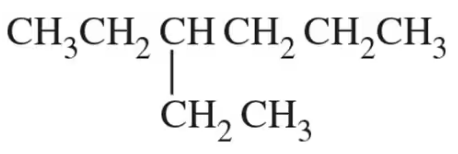
Convert the condensed structures shown to skeletal structures.
(c) Condensed chemical structures of organic compounds, illustrating the conversion to skeletal formulas.

Guida verificata passo dopo passo
1
Identify the condensed structure provided in the problem. Condensed structures represent molecules in a compact form, showing the connectivity of atoms without explicitly drawing bonds.
Understand the rules for converting condensed structures to skeletal structures: (1) Carbon atoms are represented as vertices or endpoints of lines, (2) Hydrogen atoms bonded to carbons are implied and not shown explicitly, and (3) Heteroatoms (e.g., O, N, Cl) and their attached hydrogens are explicitly drawn.
Analyze the condensed structure to determine the arrangement of carbon atoms and any functional groups or substituents. Pay attention to branching points and double or triple bonds if present.
Draw the skeletal structure by placing carbon atoms as vertices and connecting them with lines to represent bonds. Add any heteroatoms and explicitly show their attached hydrogens.
Double-check the skeletal structure to ensure it accurately represents the connectivity and bonding of the original condensed structure, including the correct number of bonds for each atom.

Risposta video verificata per un problema simile:

Questa soluzione video è stata consigliata dai nostri tutor come utile per risolvere questo problema.
Durata del video:
3m

Concetti chiave

Ecco i concetti essenziali che devi comprendere per rispondere correttamente alla domanda.

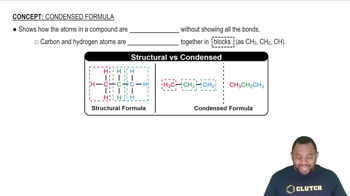
Condensed Structures

Condensed structures are a simplified way of representing molecular structures, where certain atoms and bonds are implied rather than explicitly drawn. This notation often combines atoms and their connectivity in a compact form, making it easier to visualize complex molecules without drawing every bond and atom. Understanding how to interpret these structures is crucial for converting them into skeletal structures.
Video consigliato:
Percorso guidato
1:53
Condensed Formula Concept 1

Skeletal Structures

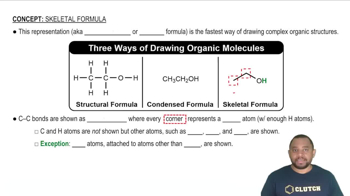
Skeletal structures, also known as line-angle formulas, represent organic molecules by showing only the carbon skeleton and functional groups. In this representation, carbon atoms are implied at the ends of lines and at intersections, while hydrogen atoms attached to carbons are usually omitted for simplicity. This format allows chemists to quickly assess the structure and connectivity of a molecule.
Video consigliato:
Percorso guidato
2:26
Skeletal Formula Concept 1

Functional Groups

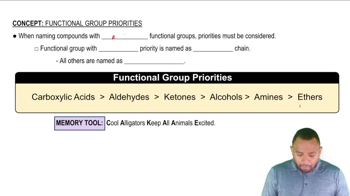
Functional groups are specific groups of atoms within molecules that are responsible for the characteristic chemical reactions of those molecules. They determine the properties and reactivity of organic compounds. Recognizing functional groups is essential when converting condensed structures to skeletal structures, as they often dictate how the molecule will behave in chemical reactions.
Video consigliato:
Percorso guidato
1:11
Functional Group Priorities Concept 1