Ch.4 Introduction to Organic Compounds
Frost - General, Organic and Biological Chemistry 4th Edition
Frost4th EditionGeneral, Organic and Biological ChemistryISBN: 9780134988696Non è quello che usi tu?Cambia libro di testo
Capitolo 1, Problema 42b

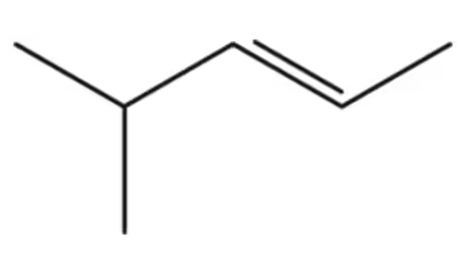
Convert the skeletal structures shown to condensed structures.
(b) Skeletal structure of an organic compound, illustrating bonds and molecular framework for conversion to condensed formula.

Guida verificata passo dopo passo
1
Identify the skeletal structure in the image. Skeletal structures represent organic molecules where carbon atoms are implied at the ends and intersections of lines, and hydrogen atoms are not explicitly shown but are assumed to satisfy the valency of carbon (4 bonds).
Determine the number of carbon atoms in the structure by counting the vertices and ends of the lines in the skeletal structure.
For each carbon atom, calculate the number of hydrogen atoms needed to satisfy the carbon's valency of 4. Remember that each line connected to a carbon represents a bond to another atom (either carbon or another element).
Write the condensed structure by explicitly listing each carbon atom and its attached hydrogens in a sequential manner. For example, a CH3 group would be written as 'CH3', and a CH2 group would be written as 'CH2'.
Combine all the groups into a single condensed formula, ensuring the structure matches the original skeletal structure. Double-check for accuracy by verifying that the total number of atoms and bonds corresponds to the skeletal structure.

Risposta video verificata per un problema simile:

Questa soluzione video è stata consigliata dai nostri tutor come utile per risolvere questo problema.
Durata del video:
1m

Concetti chiave

Ecco i concetti essenziali che devi comprendere per rispondere correttamente alla domanda.

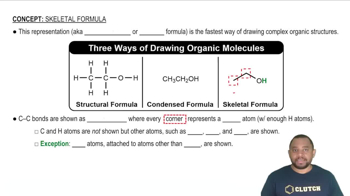
Skeletal Structures

Skeletal structures are simplified representations of organic molecules that depict the arrangement of atoms and bonds without showing all the hydrogen atoms explicitly. In these diagrams, carbon atoms are represented by vertices or ends of lines, while bonds between them are shown as lines. Understanding skeletal structures is crucial for converting them to condensed structures, as it allows one to visualize the molecular framework.
Video consigliato:
Percorso guidato
2:26
Skeletal Formula Concept 1

Condensed Structures

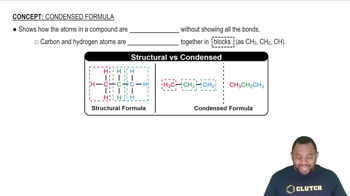
Condensed structures provide a more compact representation of molecules, where atoms are grouped together to show connectivity without the need for detailed bond representations. In these structures, hydrogen atoms attached to carbon are often implied rather than explicitly drawn. Mastery of converting skeletal structures to condensed structures is essential for simplifying complex organic molecules for easier analysis and communication.
Video consigliato:
Percorso guidato
1:53
Condensed Formula Concept 1

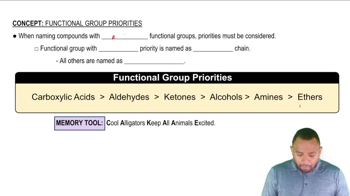
Functional Groups

Functional groups are specific groups of atoms within molecules that are responsible for the characteristic chemical reactions of those molecules. Recognizing functional groups is vital when converting skeletal to condensed structures, as they influence the molecular behavior and properties. Identifying these groups helps in accurately representing the condensed form while maintaining the chemical identity of the compound.
Video consigliato:
Percorso guidato
1:11
Functional Group Priorities Concept 1