Ch.6 Carbohydrates Life's Sweet Molecules
Frost - General, Organic and Biological Chemistry 4th Edition
Frost4th EditionGeneral, Organic and Biological ChemistryISBN: 9780134988696Non è quello che usi tu?Cambia libro di testo
Capitolo 3, Problema 49

How is the polysaccharide heparin different from the glucose polysaccharides?

Guida verificata passo dopo passo
1
Understand the structure of glucose polysaccharides: Glucose polysaccharides, such as starch and glycogen, are composed of repeating glucose units linked by glycosidic bonds. These polysaccharides primarily serve as energy storage molecules in organisms.
Learn about heparin's structure: Heparin is a polysaccharide composed of repeating disaccharide units that include glucosamine and uronic acid. It is highly sulfated, which gives it a negative charge and distinguishes it from glucose-based polysaccharides.
Compare the functions: Glucose polysaccharides like starch and glycogen are primarily involved in energy storage, while heparin functions as an anticoagulant, preventing blood clot formation by inhibiting certain enzymes in the clotting cascade.
Examine the chemical differences: Heparin contains sulfate groups and uronic acid, which are absent in glucose polysaccharides. These chemical modifications contribute to its unique biological role and properties.
Summarize the key differences: Heparin differs from glucose polysaccharides in its structure (presence of sulfate groups and uronic acid), function (anticoagulant vs. energy storage), and chemical composition (highly sulfated vs. glucose-based).

Risposta video verificata per un problema simile:

Questa soluzione video è stata consigliata dai nostri tutor come utile per risolvere questo problema.
Durata del video:
3m

Concetti chiave

Ecco i concetti essenziali che devi comprendere per rispondere correttamente alla domanda.

Polysaccharides

Polysaccharides are long chains of monosaccharide units linked by glycosidic bonds. They serve various functions in biological systems, including energy storage (like starch and glycogen) and structural roles (like cellulose). Understanding their structure and function is crucial for distinguishing different types of polysaccharides, such as heparin and glucose polysaccharides.
Video consigliato:
Percorso guidato
1:24
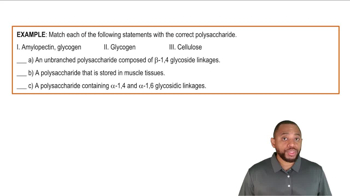
Polysaccharides Example 1

Heparin

Heparin is a specific type of polysaccharide known as a glycosaminoglycan, which is composed of repeating disaccharide units. It is primarily found in connective tissues and plays a vital role in anticoagulation, preventing blood clotting. Its unique structure, which includes sulfate groups, differentiates it from simpler glucose polysaccharides.

Glucose Polysaccharides

Glucose polysaccharides, such as starch and glycogen, are composed solely of glucose monomers. They primarily function as energy storage molecules in plants and animals. Unlike heparin, these polysaccharides do not contain the sulfate groups or the specific disaccharide structure that characterize heparin, leading to different biological roles and properties.
Video consigliato:
Percorso guidato
1:24
Polysaccharides Example 1