Ch.6 Carbohydrates Life's Sweet Molecules
Frost - General, Organic and Biological Chemistry 4th Edition
Frost4th EditionGeneral, Organic and Biological ChemistryISBN: 9780134988696Non è quello che usi tu?Cambia libro di testo
Capitolo 3, Problema 53

Explain the difference between an oligosaccharide and a polysaccharide.

Guida verificata passo dopo passo
1
Understand that carbohydrates are classified based on the number of sugar units they contain.
Recognize that oligosaccharides are carbohydrates composed of 3 to 10 monosaccharide units linked together.
Identify that polysaccharides are larger carbohydrates made up of more than 10 monosaccharide units, often hundreds or thousands.
Note that oligosaccharides often play roles in cell recognition and signaling, while polysaccharides serve as energy storage (e.g., starch, glycogen) or structural components (e.g., cellulose).
Remember that the distinction between oligosaccharides and polysaccharides is based on the number of sugar units, which affects their biological function and properties.

Risposta video verificata per un problema simile:

Questa soluzione video è stata consigliata dai nostri tutor come utile per risolvere questo problema.
Durata del video:
2m

Concetti chiave

Ecco i concetti essenziali che devi comprendere per rispondere correttamente alla domanda.

Oligosaccharides

Oligosaccharides are carbohydrates composed of a small number of monosaccharide units, typically ranging from two to ten. They are formed through glycosidic bonds and can be found in various natural sources, such as vegetables and legumes. Oligosaccharides play important roles in biological processes, including cell recognition and signaling.
Video consigliato:
Percorso guidato
1:29
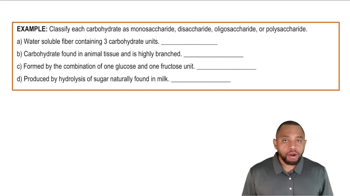
Classification of Carbohydrates Example 1

Polysaccharides

Polysaccharides are large, complex carbohydrates made up of long chains of monosaccharide units, often exceeding ten and sometimes reaching thousands. They serve various functions, such as energy storage (e.g., starch and glycogen) and structural support (e.g., cellulose in plants). Their size and branching can significantly affect their properties and biological roles.
Video consigliato:
Percorso guidato
1:24
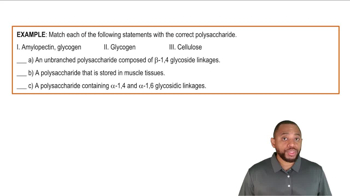
Polysaccharides Example 1

Glycosidic Bonds

Glycosidic bonds are covalent linkages formed between monosaccharides during the synthesis of oligosaccharides and polysaccharides. These bonds result from a dehydration reaction, where a water molecule is released. The type and position of glycosidic bonds influence the structure and digestibility of the carbohydrate, impacting its biological function.
Video consigliato:
Percorso guidato
1:44
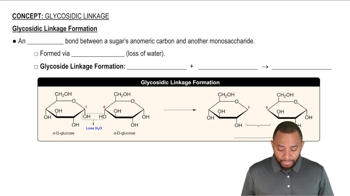
Glycosidic Linkage Formation Concept 1