Ch.7 States of Matter and Their Attractive Forces
Frost - General, Organic and Biological Chemistry 4th Edition
Frost4th EditionGeneral, Organic and Biological ChemistryISBN: 9780134988696Non è quello che usi tu?Cambia libro di testo
Capitolo 4, Problema 46

Draw a possible hydrogen bond between a molecule of cholesterol and a molecule of water.

Guida verificata passo dopo passo
1
Identify the functional groups in cholesterol that can participate in hydrogen bonding. Cholesterol contains a hydroxyl (-OH) group, which is capable of forming hydrogen bonds due to the presence of a hydrogen atom bonded to an electronegative oxygen atom.
Understand the nature of hydrogen bonding. A hydrogen bond occurs when a hydrogen atom covalently bonded to an electronegative atom (like oxygen or nitrogen) interacts with another electronegative atom that has lone pairs of electrons.
Locate the water molecule's structure. Water (H₂O) has two lone pairs of electrons on the oxygen atom and two hydrogen atoms that can participate in hydrogen bonding.
Draw the interaction between the hydroxyl group of cholesterol and the water molecule. The hydrogen atom of the hydroxyl group in cholesterol can form a hydrogen bond with one of the lone pairs on the oxygen atom of the water molecule.
Ensure proper orientation in the drawing. The hydrogen bond should be represented as a dashed line between the hydrogen atom of the hydroxyl group in cholesterol and the oxygen atom of the water molecule, showing the interaction clearly.

Risposta video verificata per un problema simile:

Questa soluzione video è stata consigliata dai nostri tutor come utile per risolvere questo problema.
Durata del video:
5m

Concetti chiave

Ecco i concetti essenziali che devi comprendere per rispondere correttamente alla domanda.

Hydrogen Bonding

Hydrogen bonding is a type of weak chemical bond that occurs when a hydrogen atom covalently bonded to a highly electronegative atom, such as oxygen or nitrogen, experiences an attraction to another electronegative atom. In the context of cholesterol and water, the hydrogen atoms in water can form hydrogen bonds with the oxygen atoms in cholesterol, facilitating interactions between these molecules.
Video consigliato:
Percorso guidato
1:22
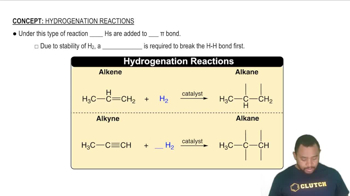
Hydrogenation Reactions Concept 1

Cholesterol Structure

Cholesterol is a lipid molecule characterized by a complex structure that includes a hydrophobic steroid ring system and a small hydrophilic hydroxyl group. This unique structure allows cholesterol to interact with both hydrophobic and hydrophilic environments, making it essential for membrane fluidity and stability in biological systems, as well as influencing its interactions with water molecules.
Video consigliato:
Percorso guidato
1:01
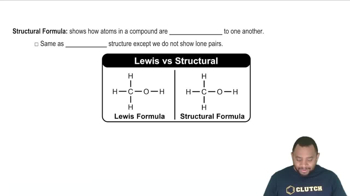
Structural Formula Concept 2

Polarity of Water

Water is a polar molecule, meaning it has a partial positive charge on one side (due to hydrogen atoms) and a partial negative charge on the other side (due to the oxygen atom). This polarity enables water to form hydrogen bonds with other polar molecules, such as cholesterol, which enhances solubility and interaction in biological systems, playing a crucial role in biochemical processes.
Video consigliato:
Percorso guidato
01:34
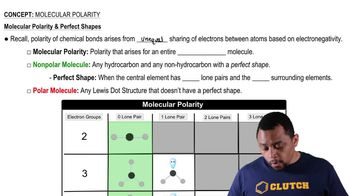
Molecular Polarity (Simplified) Concept 1