Ch.7 States of Matter and Their Attractive Forces
Frost - General, Organic and Biological Chemistry 4th Edition
Frost4th EditionGeneral, Organic and Biological ChemistryISBN: 9780134988696Non è quello che usi tu?Cambia libro di testo
Capitolo 4, Problema 91

Describe other components present in a cell membrane and their relative location.

Guida verificata passo dopo passo
1
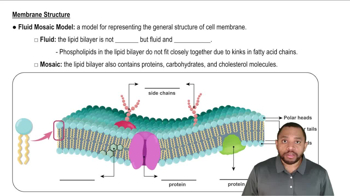
The cell membrane, also known as the plasma membrane, is primarily composed of a phospholipid bilayer. This bilayer forms the structural foundation of the membrane, with hydrophilic (water-attracting) heads facing outward and hydrophobic (water-repelling) tails facing inward.
Proteins are embedded within the phospholipid bilayer. These proteins can be integral (spanning the entire membrane) or peripheral (attached to the surface of the membrane). Integral proteins often function as channels or transporters, while peripheral proteins are involved in signaling or structural support.
Cholesterol molecules are interspersed within the phospholipid bilayer. They help maintain membrane fluidity by preventing the fatty acid chains of phospholipids from packing too closely together, especially at lower temperatures.
Carbohydrates are attached to proteins (forming glycoproteins) or lipids (forming glycolipids) on the extracellular surface of the membrane. These carbohydrate chains play a role in cell recognition, signaling, and adhesion.
The cytoskeleton, located on the intracellular side of the membrane, interacts with membrane proteins to provide structural support and maintain the shape of the cell. This interaction also helps anchor the membrane in place.

Risposta video verificata per un problema simile:

Questa soluzione video è stata consigliata dai nostri tutor come utile per risolvere questo problema.
Durata del video:
2m

Concetti chiave

Ecco i concetti essenziali che devi comprendere per rispondere correttamente alla domanda.

Phospholipid Bilayer

The cell membrane is primarily composed of a phospholipid bilayer, which consists of two layers of phospholipids. Each phospholipid has a hydrophilic (water-attracting) 'head' and two hydrophobic (water-repelling) 'tails.' This arrangement creates a semi-permeable membrane that allows selective passage of substances, with the hydrophilic heads facing outward towards the aqueous environment and the hydrophobic tails facing inward.
Video consigliato:
Percorso guidato
2:34
Cell Membranes Concept 2

Membrane Proteins

Membrane proteins are integral and peripheral proteins embedded in or associated with the phospholipid bilayer. Integral proteins span the membrane and can function as channels or transporters, while peripheral proteins are attached to the membrane's surface and play roles in signaling and maintaining the cell's shape. Their specific locations and functions are crucial for various cellular processes, including communication and transport.
Video consigliato:
Percorso guidato
1:00
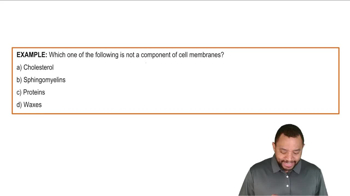
Cell Membranes Example 1

Cholesterol

Cholesterol molecules are interspersed within the phospholipid bilayer, contributing to membrane fluidity and stability. They help maintain the membrane's integrity by preventing the fatty acid chains of phospholipids from packing too closely together, which is essential for the proper functioning of membrane proteins and overall cell function. Cholesterol's presence is particularly important in maintaining membrane flexibility across varying temperatures.
Video consigliato:
Percorso guidato
1:35
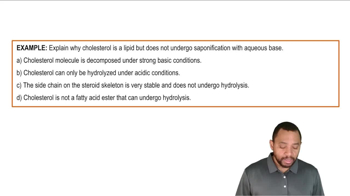
Steroids Example 1