Ch.7 States of Matter and Their Attractive Forces
Frost - General, Organic and Biological Chemistry 4th Edition
Frost4th EditionGeneral, Organic and Biological ChemistryISBN: 9780134988696Non è quello che usi tu?Cambia libro di testo
Capitolo 4, Problema 98

Fats and oils are both triglycerides. Consider the shortening Crisco®. Would scientists consider this a fat or an oil? What about margarine?

Guida verificata passo dopo passo
1
Understand that both fats and oils are types of triglycerides, which are esters derived from glycerol and three fatty acids.
Recognize that the primary difference between fats and oils is their state at room temperature: fats are solid, while oils are liquid.
Consider the composition of Crisco®, which is a type of shortening. Shortenings are typically solid at room temperature, indicating they are fats.
Examine margarine, which is also solid at room temperature, suggesting it is classified as a fat. However, margarine is often made from hydrogenated vegetable oils, which are originally liquid oils that have been chemically altered to become solid.
Conclude that both Crisco® and margarine are considered fats due to their solid state at room temperature, despite their different origins and processing methods.

Risposta video verificata per un problema simile:

Questa soluzione video è stata consigliata dai nostri tutor come utile per risolvere questo problema.
Durata del video:
1m

Concetti chiave

Ecco i concetti essenziali che devi comprendere per rispondere correttamente alla domanda.

Triglycerides

Triglycerides are the main constituents of body fat in humans and animals, as well as vegetable fat. They are composed of glycerol and three fatty acids, which can vary in saturation. The structure of the fatty acids determines whether a triglyceride is classified as a fat (solid at room temperature) or an oil (liquid at room temperature).
Video consigliato:
Percorso guidato
0:57
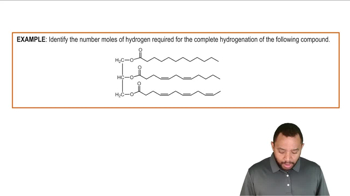
Triacylglycerol Reactions: Hydrogenation Example 1

Saturation

Saturation refers to the presence of double bonds in the fatty acid chains of triglycerides. Saturated fats have no double bonds, making them solid at room temperature, while unsaturated fats contain one or more double bonds, resulting in a liquid state. This distinction is crucial for classifying substances like Crisco® and margarine.
Video consigliato:
Percorso guidato
0:57
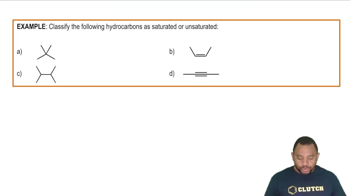
Saturated and Unsaturated Hydrocarbons Example 2

Culinary Applications

Culinary applications refer to how fats and oils are used in cooking and food preparation. Crisco® is often used as a shortening, which is a solid fat that provides texture and moisture in baked goods, while margarine, which can be a blend of fats, is used as a butter substitute. Understanding these applications helps in determining whether a product is categorized as a fat or an oil.
Video consigliato:
Percorso guidato
04:09
The Ideal Gas Law Applications