Ch.10 Acids and Bases
McMurry - Fundamentals of General, Organic, and Biological Chemistry 8th Edition
McMurry8th EditionFundamentals of General, Organic, and Biological ChemistryISBN: 9780134015187Non è quello che usi tu?Cambia libro di testo
Capitolo 10, Problema 34

Electrostatic potential maps of acetic acid (CH3CO2H) and ethyl alcohol (CH3CH2OH) are shown. Identify the most acidic hydrogen in each, and tell which of the two is likely to be the stronger acid.
<IMAGE>

Guida verificata passo dopo passo
1
Step 1: Examine the electrostatic potential maps provided for acetic acid (CH₃CO₂H) and ethyl alcohol (CH₃CH₂OH). The colors on the map indicate electron density, with red representing areas of high electron density (negative charge) and blue representing areas of low electron density (positive charge). Identify regions near hydrogen atoms to determine their acidity.
Step 2: In acetic acid (CH₃CO₂H), the hydrogen atom bonded to the oxygen in the carboxylic acid group (-CO₂H) is the most acidic. This is because the oxygen atoms in the carboxylic group are highly electronegative, pulling electron density away from the hydrogen, making it easier to lose as a proton (H⁺).
Step 3: In ethyl alcohol (CH₃CH₂OH), the hydrogen atom bonded to the oxygen in the hydroxyl group (-OH) is the most acidic. However, the alcohol group is less acidic compared to the carboxylic acid group because the single oxygen atom in the hydroxyl group does not stabilize the negative charge as effectively as the carboxylic group.
Step 4: Compare the acidity of acetic acid and ethyl alcohol. Acetic acid is likely to be the stronger acid because the carboxylic acid group can stabilize the negative charge on the conjugate base (CH₃CO₂⁻) through resonance, whereas the hydroxyl group in ethyl alcohol cannot.
Step 5: Conclude that the most acidic hydrogen in acetic acid is the one in the carboxylic acid group (-CO₂H), and the most acidic hydrogen in ethyl alcohol is the one in the hydroxyl group (-OH). Acetic acid is the stronger acid due to the resonance stabilization of its conjugate base.

Risposta video verificata per un problema simile:

Questa soluzione video è stata consigliata dai nostri tutor come utile per risolvere questo problema.
Durata del video:
5m

Concetti chiave

Ecco i concetti essenziali che devi comprendere per rispondere correttamente alla domanda.

Acidity and Acid Strength

Acidity refers to the ability of a substance to donate protons (H⁺ ions) in a solution. The strength of an acid is determined by its tendency to dissociate in water, with stronger acids dissociating more completely. In organic compounds, factors such as electronegativity, resonance, and inductive effects influence acid strength, making some compounds more likely to release protons than others.
Video consigliato:
Percorso guidato
00:50
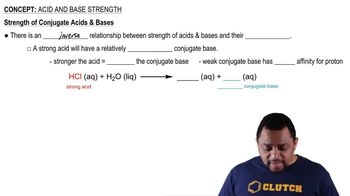
Acid and Base Strength Concept 3

Electrostatic Potential Maps

Electrostatic potential maps visually represent the distribution of electron density in a molecule, indicating regions of positive and negative charge. These maps help identify areas of high acidity by showing where protons are more likely to be released. In the context of acetic acid and ethyl alcohol, these maps can highlight the most acidic hydrogen atoms based on their surrounding electronic environment.
Video consigliato:
Percorso guidato
02:04
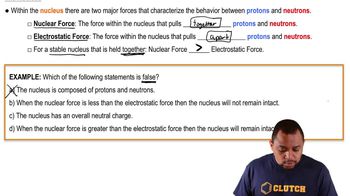
The Atom (Simplified) Example 2

Inductive Effect

The inductive effect refers to the electron-withdrawing or electron-donating influence of substituents on a molecule's acidity. Electronegative atoms or groups, such as halogens, can stabilize the negative charge of the conjugate base formed after deprotonation, enhancing acidity. In comparing acetic acid and ethyl alcohol, the presence of electron-withdrawing groups can significantly affect their relative acid strengths.
Video consigliato:
Percorso guidato
04:38
Solubility: Temperature Effect Concept 1