Indietro
Problema 1
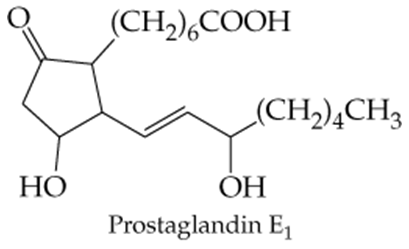
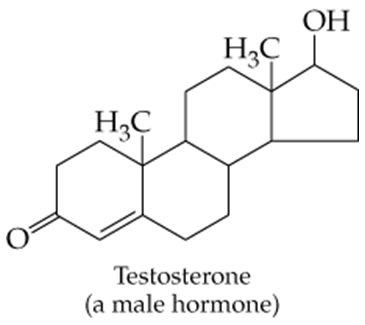
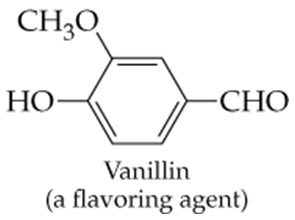
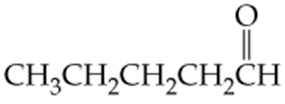
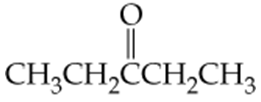
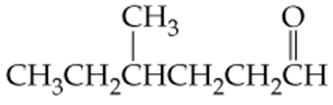
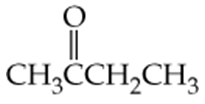
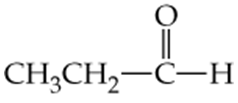
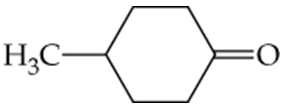
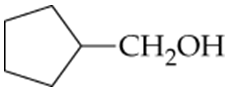
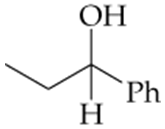
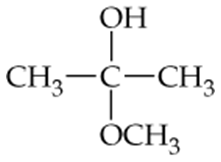
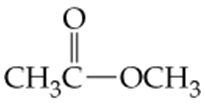
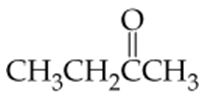
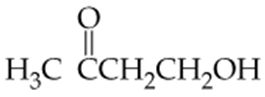
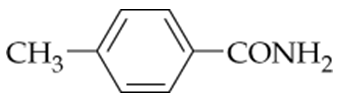
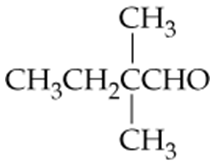
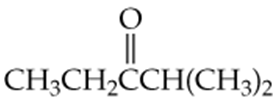
Which of the following molecules contain aldehyde or ketone functional groups? You may want to refer to Table 15.1, Table 12.1, and Figure 15.3 to help in your identification. Copy the formulas and circle these functional groups.
a.
b.
c.
d. C4H9COCH3
e. C4H9CHO
Problema 3
Draw structures corresponding to the following names:
a. Octanal
b. Methyl phenyl ketone
c. 4-Methylhexanal
d. Methyl tert-butyl ketone
Problema 4
Give systematic, IUPAC names for the following compounds. Redraw each in line structure format.
a.
b.
c.
d. Dipropyl ketone
Problema 7
For each compound shown next (a–d), indicate whether the compound is polar or nonpolar, and whether it is soluble or insoluble in water.
a.
b.
c. CH3CH2CH2CH2CH3
d.
Problema 8
Why do aldehydes and ketones have lower boiling points than alcohols with similar molecular weights? Why are their boiling points higher than those of alkanes with similar molecular weights?
Problema 12
What ketones or aldehydes might be reduced to yield the following alcohols?
a.
b.
c. HOCH2–CH2–CH2OH
Problema 14c
Determine whether the following compounds are acetals or ketals. Draw the structure of the aldehyde or ketone it came from.
c.
Problema 15.48
Aldosterone is a key steroid involved in controlling the sodium–potassium balance in the body. Identify the functional groups in aldosterone. <IMAGE>
Problema 15b
Draw the structures of the hemiacetals or hemiketals formed in these reactions:
b.
Problema 17
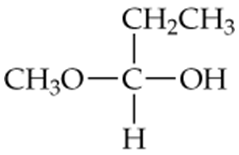
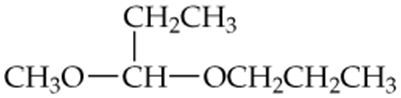
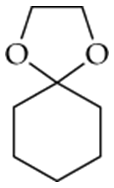
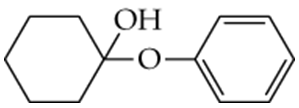
For each compound shown next, determine whether it is a hemiacetal, a hemiketal, an acetal, or a ketal.
a.
b.
c.
d.
Problema 20a
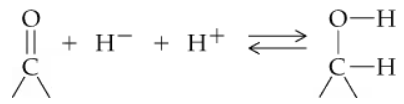
The carbonyl group can be reduced by addition of a hydride ion (H–) and (H+) a proton. Removal of H– and H+ from an alcohol results in a carbonyl group.
a. To which atom of the carbonyl is the hydride ion added and why?
Problema 20b
The carbonyl group can be reduced by addition of a hydride ion (H–) and (H+) a proton. Removal of H– and H+ from an alcohol results in a carbonyl group.
b. In the reaction, indicate which direction represents reduction and which represents oxidation.
Problema 21
A fundamental difference between aldehydes and ketones is that one can be oxidized to carboxylic acids but the other cannot. Which is which? Give an example of a test to differentiate aldehydes from ketones.
Problema 24
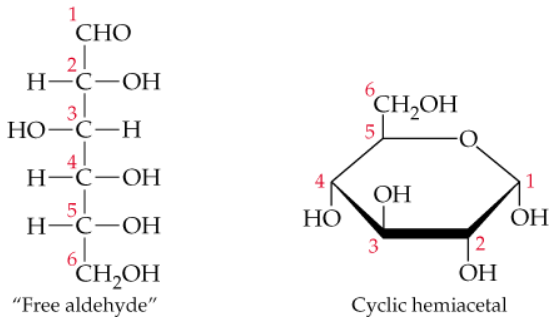
Glucose is the major sugar in mammalian blood. We often see it represented as either the "free aldehyde" or the cyclic hemiacetal forms shown here. Of the two forms of glucose, the cyclic hemiacetal is the preferred form found in blood. Can you suggest two reasons why?
Problema 26a
Draw a structure for a compound that meets each of the following descriptions:
a. A 6-carbon cyclic ketone with a methyl group on the beta carbon
Problema 26b
Draw a structure for a compound that meets each of the following descriptions:
b. An aldehyde with four carbons
Problema 26c
Draw a structure for a compound that meets each of the following descriptions:
c. An alpha-bromoaldehyde, C4H7BrO
Problema 27b
Draw a structure for a compound that meets each of the following descriptions:
b. An 8-carbon ketone with six carbons as its longest chain
Problema 27d
Draw a structure for a compound that meets each of the following descriptions:
d. A cyclic alpha-hydroxyketone, C5H8O2
Problema 28a
Indicate which compounds contain aldehyde or ketone carbonyl groups.
a.
Problema 28c
Indicate which compounds contain aldehyde or ketone carbonyl groups.
c. CH3CH2–O–CH2–CHO
Problema 28f
Indicate which compounds contain aldehyde or ketone carbonyl groups.
f.
Problema 29c
Redraw each of the following in line structure format. Indicate which compounds have an aldehyde carbonyl group, a ketone carbonyl group, or neither.
c.
Problema 29e
Redraw each of the following in line structure format. Indicate which compounds have an aldehyde carbonyl group, a ketone carbonyl group, or neither.
e. CH3CH2COCH2CH3
Problema 30a
Draw structures corresponding to the following aldehyde and ketone names:
a. 3-Methylpentanal
Problema 31b
Draw structures corresponding to the following aldehyde and ketone names:
b. 4-Ethyl-2-isopropylhexanal
Problema 31e
Draw structures corresponding to the following aldehyde and ketone names:
e. 1,1,1-Trichloro-3-pentanone
Problema 32a
Give systematic names for the following aldehydes and ketones:
a.
Problema 33b
Give IUPAC names for the following aldehydes and ketones:
b.
Problema 34a
The following names are incorrect. What is wrong with each?
a. 1-Pentanone