Ch.11 Nuclear Chemistry
McMurry - Fundamentals of General, Organic, and Biological Chemistry 8th Edition
McMurry8th EditionFundamentals of General, Organic, and Biological ChemistryISBN: 9780134015187Non è quello che usi tu?Cambia libro di testo
Capitolo 11, Problema 52

Bismuth-212 attaches readily to monoclonal antibodies and is used in the treatment of various cancers. This bismuth-212 is formed after the parent isotope undergoes a decay series consisting of four α decays and one β decay (the decays could be in any order). What is the parent isotope for this decay series?

Guida verificata passo dopo passo
1
Identify the changes in atomic number and mass number caused by each type of decay: An α (alpha) decay decreases the atomic number by 2 and the mass number by 4, while a β (beta) decay increases the atomic number by 1 without changing the mass number.
Determine the net change in atomic number and mass number after the decay series: Since there are four α decays and one β decay, the total change in atomic number is (4 × -2) + (1 × +1) = -7, and the total change in mass number is 4 × -4 = -16.
Write the nuclear equation for the decay series in reverse: Start with the known isotope, bismuth-212 (Bi-212), which has an atomic number of 83 and a mass number of 212. Add the changes in atomic number and mass number to determine the parent isotope. The parent isotope's atomic number is 83 + 7 = 90, and its mass number is 212 + 16 = 228.
Use the periodic table to identify the element with atomic number 90. This element is thorium (Th). Therefore, the parent isotope is thorium-228 (Th-228).
Verify the solution by checking the decay series: Confirm that starting with Th-228 and applying four α decays and one β decay results in Bi-212. This ensures the calculations and reasoning are correct.

Risposta video verificata per un problema simile:

Questa soluzione video è stata consigliata dai nostri tutor come utile per risolvere questo problema.
Durata del video:
4m

Concetti chiave

Ecco i concetti essenziali che devi comprendere per rispondere correttamente alla domanda.

Decay Series

A decay series refers to a sequence of radioactive decays that a parent isotope undergoes to transform into a stable or different isotope. In this context, the parent isotope decays through a series of alpha (α) and beta (β) decays, resulting in the formation of bismuth-212. Understanding the types of decay and their order is crucial for identifying the parent isotope.
Video consigliato:
Percorso guidato
01:02
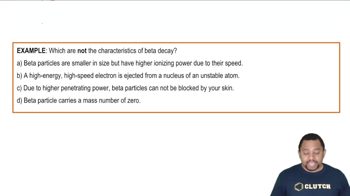
Characteristics of Beta Particles Example

Alpha Decay

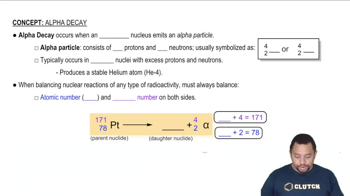
Alpha decay is a type of radioactive decay in which an atomic nucleus emits an alpha particle, consisting of two protons and two neutrons. This process decreases the atomic number by two and the mass number by four, leading to the formation of a new element. Recognizing how alpha decay affects the parent isotope is essential for tracing the decay series to its origin.
Video consigliato:

Beta Decay

Beta decay is a radioactive decay process where a neutron in the nucleus is transformed into a proton, emitting a beta particle (an electron or positron) in the process. This increases the atomic number by one while keeping the mass number unchanged. Understanding beta decay is important for determining the transformations that occur in the decay series leading to bismuth-212.
Video consigliato:
Percorso guidato
01:02
Characteristics of Beta Particles Example