Ch.2 Atoms and the Periodic Table
McMurry - Fundamentals of General, Organic, and Biological Chemistry 8th Edition
McMurry8th EditionFundamentals of General, Organic, and Biological ChemistryISBN: 9780134015187Non è quello che usi tu?Cambia libro di testo
Capitolo 2, Problema 14

How many electrons are present in an atom in which the first and second shells and the 3s subshell are filled? Name the element.

Guida verificata passo dopo passo
1
Determine the maximum number of electrons that can be held in the first shell (n=1). The first shell contains only the 1s subshell, which can hold a maximum of 2 electrons.
Determine the maximum number of electrons that can be held in the second shell (n=2). The second shell contains the 2s and 2p subshells. The 2s subshell can hold 2 electrons, and the 2p subshell can hold 6 electrons, for a total of 8 electrons in the second shell.
Determine the number of electrons in the 3s subshell. The 3s subshell can hold a maximum of 2 electrons, as it is a single orbital.
Add the total number of electrons from the first shell, second shell, and 3s subshell: \( 2 + 8 + 2 \). This gives the total number of electrons in the atom.
Identify the element by matching the total number of electrons to its atomic number on the periodic table. The atomic number corresponds to the number of protons (and electrons in a neutral atom).

Risposta video verificata per un problema simile:

Questa soluzione video è stata consigliata dai nostri tutor come utile per risolvere questo problema.
Durata del video:
5m

Concetti chiave

Ecco i concetti essenziali che devi comprendere per rispondere correttamente alla domanda.

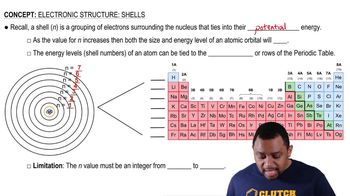
Electron Shells

Electron shells are the regions around an atom's nucleus where electrons are likely to be found. The first shell can hold up to 2 electrons, the second shell can hold up to 8 electrons, and subsequent shells can hold more. Understanding how many electrons each shell can accommodate is crucial for determining the total number of electrons in an atom.
Video consigliato:
Percorso guidato
02:29
Electronic Structure: Shells Concept 1

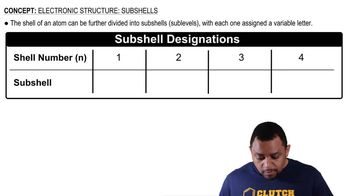
Subshells

Subshells are subdivisions of electron shells that contain orbitals where electrons reside. The 's' subshell can hold a maximum of 2 electrons. In the context of the question, the 3s subshell indicates that the third shell has its 's' orbital filled, contributing to the total electron count in the atom.
Video consigliato:
Percorso guidato
01:06
Electronic Structure: Subshells Concept 1

Element Identification

Identifying an element based on its electron configuration involves knowing the total number of electrons, which corresponds to the atomic number of the element. In this case, filling the first and second shells (2 + 8 = 10) and the 3s subshell (2) results in a total of 12 electrons, which corresponds to the element magnesium (Mg) on the periodic table.
Video consigliato:
Percorso guidato
01:14
Valence Electrons of Elements (Simplified) Example 1