
Ch.2 Atoms and the Periodic Table
McMurry - Fundamentals of General, Organic, and Biological Chemistry 8th Edition
McMurry8th EditionFundamentals of General, Organic, and Biological ChemistryISBN: 9780134015187Non è quello che usi tu?Cambia libro di testo
Capitolo 2, Problema 70

Use arrows to show electron pairing in the valence p subshell of
a. Sulfur
b. Bromine
c. Silicon

Guida verificata passo dopo passo
1
Step 1: Determine the atomic number of each element (Sulfur, Bromine, and Silicon) to identify the total number of electrons. Sulfur has an atomic number of 16, Bromine has an atomic number of 35, and Silicon has an atomic number of 14.
Step 2: Write the electron configuration for each element, focusing on the valence shell. For Sulfur: 1s² 2s² 2p⁶ 3s² 3p⁴, for Bromine: 1s² 2s² 2p⁶ 3s² 3p⁶ 4s² 3d¹⁰ 4p⁵, and for Silicon: 1s² 2s² 2p⁶ 3s² 3p².
Step 3: Identify the valence p subshell for each element. For Sulfur, the 3p subshell has 4 electrons; for Bromine, the 4p subshell has 5 electrons; and for Silicon, the 3p subshell has 2 electrons.
Step 4: Use Hund's rule to distribute the electrons in the p subshell. Electrons will occupy separate orbitals first before pairing. For Sulfur (3p⁴), there will be two paired electrons and two unpaired electrons. For Bromine (4p⁵), there will be two paired electrons and three unpaired electrons. For Silicon (3p²), there will be two unpaired electrons and no paired electrons.
Step 5: Represent the electron pairing using arrows in the p orbitals. For example, for Sulfur's 3p subshell: ↑↓ ↑ ↑ (two paired and two unpaired electrons). For Bromine's 4p subshell: ↑↓ ↑↓ ↑ (two paired and three unpaired electrons). For Silicon's 3p subshell: ↑ ↑ (two unpaired electrons).

Risposta video verificata per un problema simile:

Questa soluzione video è stata consigliata dai nostri tutor come utile per risolvere questo problema.
Durata del video:
6m

Concetti chiave

Ecco i concetti essenziali che devi comprendere per rispondere correttamente alla domanda.

Electron Configuration

Electron configuration describes the distribution of electrons in an atom's orbitals. For elements like sulfur, bromine, and silicon, understanding their electron configurations helps determine how electrons are arranged in the valence shell, particularly in the p subshell, which is crucial for visualizing electron pairing.
Video consigliato:
Percorso guidato
01:08
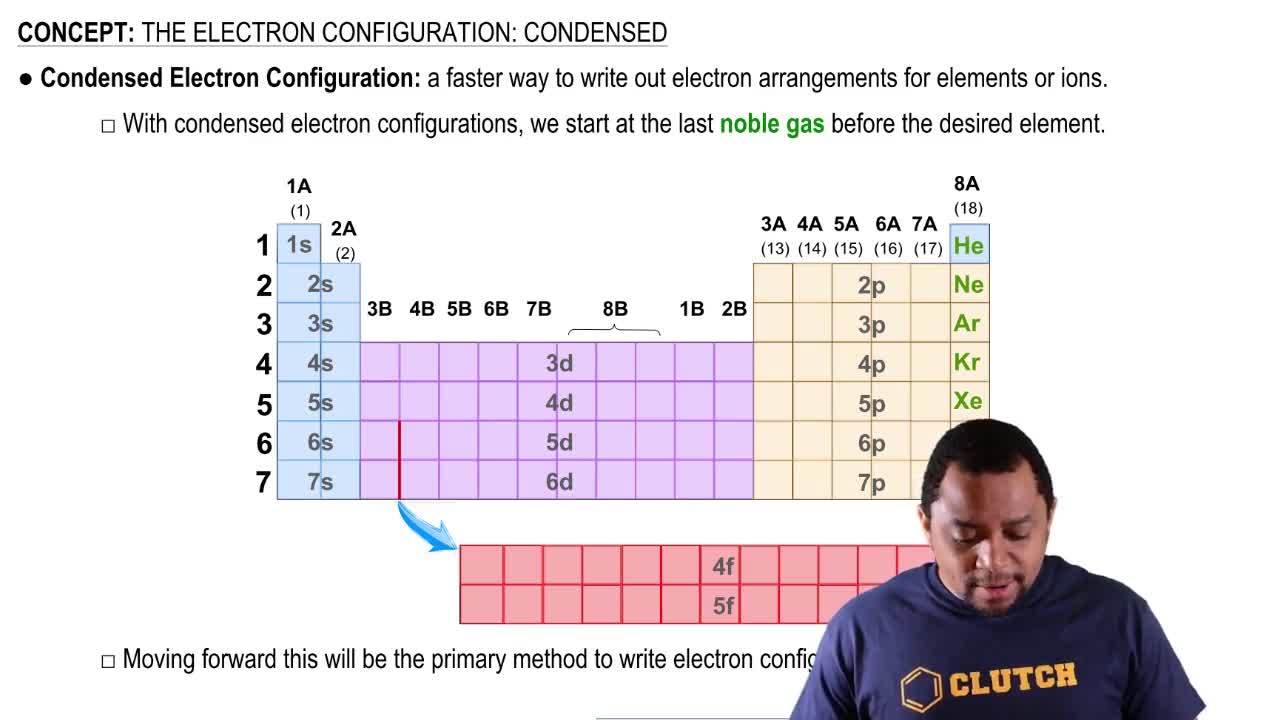
The Electron Configuration: Condensed

Valence Electrons

Valence electrons are the outermost electrons of an atom and are involved in chemical bonding. The number of valence electrons influences how atoms interact with each other. For sulfur, bromine, and silicon, identifying their valence electrons is essential for accurately representing electron pairing in the p subshell.
Video consigliato:
Percorso guidato
01:55
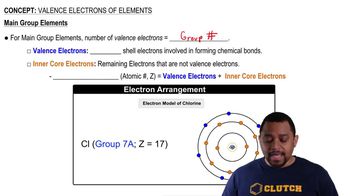
Valence Electrons of Elements (Simplified) Concept 1

Pauli Exclusion Principle

The Pauli Exclusion Principle states that no two electrons in an atom can have the same set of quantum numbers, which means that an orbital can hold a maximum of two electrons with opposite spins. This principle is fundamental when illustrating electron pairing in the p subshell, as it dictates how electrons are arranged and paired within the orbitals.
Video consigliato:
Percorso guidato
09:34
The following is an endothermic reaction where Kc = 6.73 x 10³.For each of the choices below predict in which direction the reaction will proceed