
Ch.4 Molecular Compounds
McMurry - Fundamentals of General, Organic, and Biological Chemistry 8th Edition
McMurry8th EditionFundamentals of General, Organic, and Biological ChemistryISBN: 9780134015187Non è quello che usi tu?Cambia libro di testo
Capitolo 4, Problema 2a,b,c,d

How many covalent bonds are formed by each atom in the following molecules? Draw molecules using the electron-dot-symbols and lines to show the covalent bonds.
a. PH3
b. H2Se
c. HCl
d. SiF

Guida verificata passo dopo passo
1
Step 1: Understand the concept of covalent bonding. Covalent bonds are formed when atoms share electrons to achieve a full outer shell. The number of covalent bonds an atom forms depends on its valence electrons and the need to complete its octet (or duet for hydrogen).
Step 2: Analyze molecule PH₃. Phosphorus (P) has 5 valence electrons and needs 3 more to complete its octet. It forms 3 covalent bonds with 3 hydrogen atoms, each contributing 1 electron. Draw the molecule with P in the center, single bonds to 3 H atoms, and a lone pair of electrons on P.
Step 3: Analyze molecule H₂Se. Selenium (Se) has 6 valence electrons and needs 2 more to complete its octet. It forms 2 covalent bonds with 2 hydrogen atoms. Draw the molecule with Se in the center, single bonds to 2 H atoms, and 2 lone pairs of electrons on Se.
Step 4: Analyze molecule HCl. Chlorine (Cl) has 7 valence electrons and needs 1 more to complete its octet. It forms 1 covalent bond with 1 hydrogen atom. Draw the molecule with Cl and H connected by a single bond, and 3 lone pairs of electrons on Cl.
Step 5: Analyze molecule SiF₄. Silicon (Si) has 4 valence electrons and needs 4 more to complete its octet. It forms 4 covalent bonds with 4 fluorine atoms. Draw the molecule with Si in the center, single bonds to 4 F atoms, and 3 lone pairs of electrons on each F atom.

Risposta video verificata per un problema simile:

Questa soluzione video è stata consigliata dai nostri tutor come utile per risolvere questo problema.
Durata del video:
7m

Concetti chiave

Ecco i concetti essenziali che devi comprendere per rispondere correttamente alla domanda.

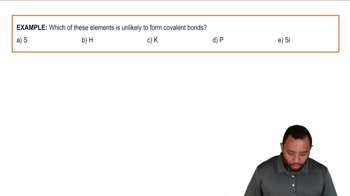
Covalent Bonds

Covalent bonds are formed when two atoms share one or more pairs of electrons. This type of bond typically occurs between nonmetals and is essential for the formation of molecules. The number of covalent bonds an atom can form is determined by its valence electrons, which are the electrons in the outermost shell.
Video consigliato:
Percorso guidato
01:04
Covalent Bonds Example 1

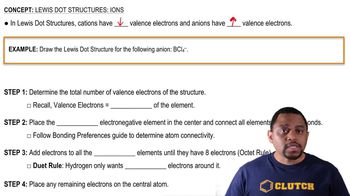
Lewis Structures

Lewis structures are diagrams that represent the bonding between atoms in a molecule and the lone pairs of electrons that may exist. They use dots to represent valence electrons and lines to represent covalent bonds. Drawing Lewis structures helps visualize how atoms are connected and the distribution of electrons, which is crucial for understanding molecular geometry and reactivity.
Video consigliato:
Percorso guidato
03:11
Lewis Dot Structures: Ions (Simplified) Concept 1

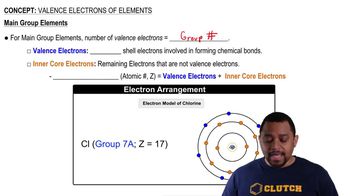
Valence Electrons

Valence electrons are the electrons located in the outermost shell of an atom and are responsible for the chemical properties of the element. The number of valence electrons determines how many covalent bonds an atom can form. For example, phosphorus has five valence electrons, allowing it to form three covalent bonds in PH₃, while other elements like silicon in SiF₄ can form four bonds due to having four valence electrons.
Video consigliato:
Percorso guidato
01:55
Valence Electrons of Elements (Simplified) Concept 1