
Ch.5 Classification & Balancing of Chemical Reactions
McMurry - Fundamentals of General, Organic, and Biological Chemistry 8th Edition
McMurry8th EditionFundamentals of General, Organic, and Biological ChemistryISBN: 9780134015187Non è quello che usi tu?Cambia libro di testo
Capitolo 5, Problema 8

Identify the oxidized reactant, the reduced reactant, the oxidizing agent, and the reducing agent in the following reactions:
a. Fe(s) + Cu2+(aq) → Fe2+(aq) + Cu(s)
b. Mg(s) + Cl2(g) → MgCl2(s)
c. 2 Al(s) + Cr2O3(s) → 2 Cr(s) + Al2O3(s)

Guida verificata passo dopo passo
1
Step 1: Understand the concepts of oxidation and reduction. Oxidation involves the loss of electrons, while reduction involves the gain of electrons. The oxidizing agent is the substance that causes oxidation (it gets reduced), and the reducing agent is the substance that causes reduction (it gets oxidized).
Step 2: Analyze reaction (a): Fe(s) + Cu₂⁺(aq) → Fe₂⁺(aq) + Cu(s). Identify the oxidation states of each element before and after the reaction. Fe starts as 0 (elemental state) and becomes Fe²⁺ (oxidized). Cu²⁺ starts as +2 and becomes Cu⁰ (reduced). Fe is the reducing agent, and Cu²⁺ is the oxidizing agent.
Step 3: Analyze reaction (b): Mg(s) + Cl₂(g) → MgCl₂(s). Mg starts as 0 (elemental state) and becomes Mg²⁺ (oxidized). Cl₂ starts as 0 (elemental state) and becomes Cl⁻ (reduced). Mg is the reducing agent, and Cl₂ is the oxidizing agent.
Step 4: Analyze reaction (c): 2 Al(s) + Cr₂O₃(s) → 2 Cr(s) + Al₂O₃(s). Al starts as 0 (elemental state) and becomes Al³⁺ (oxidized). Cr in Cr₂O₃ starts as +3 and becomes Cr⁰ (reduced). Al is the reducing agent, and Cr₂O₃ is the oxidizing agent.
Step 5: Summarize the findings for each reaction: (a) Fe is oxidized, Cu²⁺ is reduced, Fe is the reducing agent, Cu²⁺ is the oxidizing agent. (b) Mg is oxidized, Cl₂ is reduced, Mg is the reducing agent, Cl₂ is the oxidizing agent. (c) Al is oxidized, Cr₂O₃ is reduced, Al is the reducing agent, Cr₂O₃ is the oxidizing agent.

Risposta video verificata per un problema simile:

Questa soluzione video è stata consigliata dai nostri tutor come utile per risolvere questo problema.
Durata del video:
7m

Concetti chiave

Ecco i concetti essenziali che devi comprendere per rispondere correttamente alla domanda.

Oxidation and Reduction

Oxidation and reduction are chemical processes that involve the transfer of electrons between substances. Oxidation refers to the loss of electrons, resulting in an increase in oxidation state, while reduction involves the gain of electrons, leading to a decrease in oxidation state. These processes occur simultaneously in redox reactions, where one substance is oxidized and another is reduced.
Video consigliato:
Percorso guidato
0:55
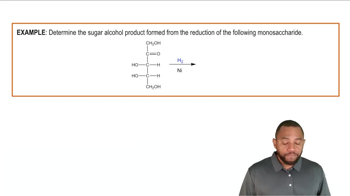
Reduction of Monosaccharides Example 1

Oxidizing and Reducing Agents

An oxidizing agent is a substance that facilitates oxidation by accepting electrons from another reactant, thereby becoming reduced itself. Conversely, a reducing agent donates electrons to another substance, causing it to be reduced while the reducing agent is oxidized. Identifying these agents is crucial for understanding the dynamics of redox reactions.
Video consigliato:
Percorso guidato
1:01
Ketoses as Reducing Sugars Example 2

Half-Reactions

Half-reactions are a way to represent oxidation and reduction processes separately, making it easier to analyze redox reactions. Each half-reaction shows either the oxidation process (loss of electrons) or the reduction process (gain of electrons) along with the corresponding species involved. This method helps in balancing redox reactions and identifying the roles of different reactants.
Video consigliato:
Percorso guidato
02:09
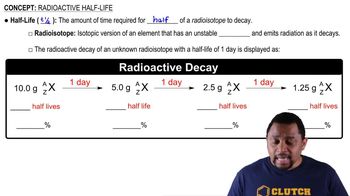
Radioactive Half-Life Concept 1