Ch.6 Chemical Reactions: Mole and Mass Relationships
McMurry - Fundamentals of General, Organic, and Biological Chemistry 8th Edition
McMurry8th EditionFundamentals of General, Organic, and Biological ChemistryISBN: 9780134015187Non è quello che usi tu?Cambia libro di testo
Capitolo 6, Problema 17

Consider the balanced chemical equation: 2A + B2 → 2AB. Given the following reaction vessel, determine the theoretical yield of product.
<IMAGE>

Guida verificata passo dopo passo
1
Step 1: Analyze the balanced chemical equation provided: 2A + B₂ → 2AB. This indicates that two molecules of A react with one molecule of B₂ to produce two molecules of AB.
Step 2: Count the number of reactant molecules in the reaction vessel. From the image, identify the red spheres as A (Y) and the blue pairs as B₂ (X₂). Count the total number of A molecules and B₂ molecules.
Step 3: Determine the limiting reactant. Use the stoichiometric ratio from the balanced equation (2A:1B₂). Compare the available quantities of A and B₂ to find which reactant will be completely consumed first.
Step 4: Calculate the theoretical yield of AB. Based on the limiting reactant, use the stoichiometric ratio to determine how many AB molecules can be formed. For every 2A and 1B₂, 2AB molecules are produced.
Step 5: Verify the calculation by ensuring that the number of AB molecules formed does not exceed the amount dictated by the limiting reactant. Confirm that any excess reactant remains unreacted.

Risposta video verificata per un problema simile:

Questa soluzione video è stata consigliata dai nostri tutor come utile per risolvere questo problema.
Durata del video:
2m

Concetti chiave

Ecco i concetti essenziali che devi comprendere per rispondere correttamente alla domanda.

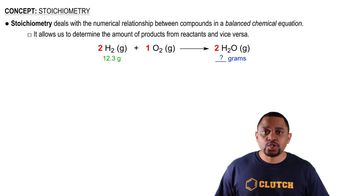
Stoichiometry

Stoichiometry is the calculation of reactants and products in chemical reactions based on the balanced equation. It allows chemists to determine the proportions of substances involved in a reaction, which is essential for predicting the theoretical yield of products. In the given equation, the coefficients indicate the molar ratios of reactants A and B2 to product AB.
Video consigliato:

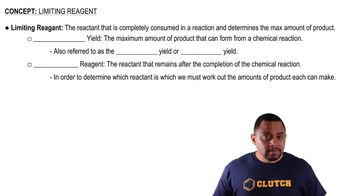
Limiting Reagent

The limiting reagent is the reactant that is completely consumed first in a chemical reaction, thus determining the maximum amount of product that can be formed. Identifying the limiting reagent is crucial for calculating the theoretical yield, as it dictates how much product can be produced based on the available quantities of reactants A and B2 in the reaction vessel.
Video consigliato:
Percorso guidato
01:30
Limiting Reagent

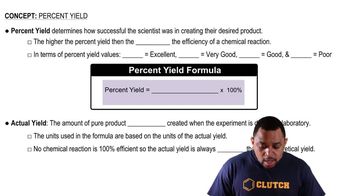
Theoretical Yield

Theoretical yield is the maximum amount of product that can be generated from a given amount of reactants, assuming complete conversion and no losses. It is calculated using stoichiometric relationships from the balanced equation and the amounts of the limiting reagent. Understanding theoretical yield is important for evaluating the efficiency of a reaction and for practical applications in laboratory and industrial settings.
Video consigliato: