

Ch.7 Chemical Reactions: Energy, Rate and Equilibrium
McMurry - Fundamentals of General, Organic, and Biological Chemistry 8th Edition
McMurry8th EditionFundamentals of General, Organic, and Biological ChemistryISBN: 9780134015187Non è quello che usi tu?Cambia libro di testo
Capitolo 7, Problema 7a

Does entropy increase or decrease in the following processes?
a. Polymeric complex carbohydrates are metabolized by the body, converted into smaller simple sugars.

Guida verificata passo dopo passo
1
Understand the concept of entropy: Entropy is a measure of the disorder or randomness in a system. Processes that increase disorder typically result in an increase in entropy, while processes that lead to more order result in a decrease in entropy.
Analyze the process described: The problem states that polymeric complex carbohydrates (large, organized molecules) are metabolized and broken down into smaller, simpler sugars. This involves breaking chemical bonds and producing smaller, more disordered molecules.
Relate the process to entropy: Breaking down a large, organized molecule into smaller, less organized molecules increases the randomness or disorder of the system. This suggests that the entropy of the system increases during this process.
Consider the surroundings: In biological systems, the breakdown of complex carbohydrates is often coupled with energy release. While the system's entropy increases, the overall entropy of the universe (system + surroundings) also increases due to the release of heat.
Conclude the analysis: Based on the breakdown of large molecules into smaller ones and the increase in disorder, the entropy of the system increases during the metabolism of polymeric complex carbohydrates into simple sugars.

Risposta video verificata per un problema simile:

Questa soluzione video è stata consigliata dai nostri tutor come utile per risolvere questo problema.
Durata del video:
1m

Concetti chiave

Ecco i concetti essenziali che devi comprendere per rispondere correttamente alla domanda.

Entropy

Entropy is a measure of the disorder or randomness in a system. In thermodynamics, it is often associated with the second law, which states that the total entropy of an isolated system can never decrease over time. This concept is crucial for understanding how energy transformations occur and how they affect the state of matter.
Video consigliato:
Percorso guidato
00:54
Entropy (Simplified) Concept 1

Metabolism

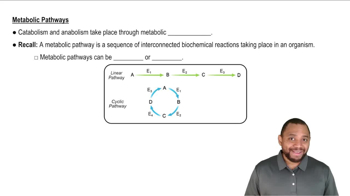
Metabolism refers to the biochemical processes that occur within living organisms to maintain life. It includes catabolic reactions, which break down complex molecules into simpler ones, releasing energy, and anabolic reactions, which build complex molecules from simpler ones. Understanding metabolism is essential for analyzing how the body processes nutrients and the associated changes in entropy.
Video consigliato:
Percorso guidato
0:52
Metabolic Pathways Concept 2

Complex Carbohydrates

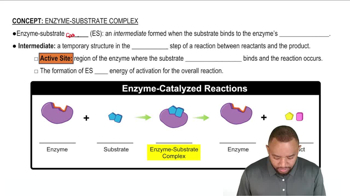
Complex carbohydrates are large molecules made up of long chains of sugar units, which the body breaks down into simpler sugars during digestion. This process involves hydrolysis, where water is used to break the bonds between sugar units. The breakdown of these complex carbohydrates typically leads to an increase in entropy, as the system transitions from a more ordered state to a more disordered one.
Video consigliato:
Percorso guidato
2:32
Enzyme-Substrate Complex Concept 1
Pratica correlata
Domanda del libro di testo

In photosynthesis, green plants convert carbon dioxide and water into glucose (C6H12O6) according to the following equation:

6 CO2(g) + 6 H2O(l) → C6H12O6(aq) + 6 O2(g)

a. Estimate ∆H for the reaction using bond dissociation energies from Table 7.1. Give your answer in kcal/mol and kJ/mol. (C6H12O6 has five C―C bonds, seven C―H bonds, seven C―O bonds, and five O―H bonds).

1656
views
Domanda del libro di testo

Do the following reactions favor reactants or products at equilibrium? Give relative concentrations at equilibrium.

a. Sucrose(aq) + H2O(l) ⇌ Glucose(aq) + Fructose(aq) K = 1.4 × 10⁵

1623
views
Domanda del libro di testo

The following equation shows the conversion of aluminum oxide (from the ore bauxite) to aluminum:

2 Al2O3(s) → 4 Al(s) + 3 O2(g) ∆H = +801 kcal/mol (+3350 kJ/mol)

c. How many kilocalories are required to produce 10.0 g of aluminum? How many kilojoules?

1961
views
Domanda del libro di testo

Do the following reactions favor reactants or products at equilibrium? Give relative concentrations at equilibrium.

c. Fe2O3(s) + 3 CO(g) ⇌ 2 Fe(s) + 3 CO2(g) K (at 727 °C) = 24.2

1781
views
Domanda del libro di testo

Does entropy increase or decrease in the following processes?

c. 2 SO2(g) + O2(g) → 2 SO3(g)

1361
views
Domanda del libro di testo

In photosynthesis, green plants convert carbon dioxide and water into glucose (C6H12O6) according to the following equation:

6 CO2(g) + 6 H2O(l) → C6H12O6(aq) + 6 O2(g)

b. Is the reaction endothermic or exothermic?

2749
views