Ch.7 Chemical Reactions: Energy, Rate and Equilibrium
McMurry - Fundamentals of General, Organic, and Biological Chemistry 8th Edition
McMurry8th EditionFundamentals of General, Organic, and Biological ChemistryISBN: 9780134015187Non è quello che usi tu?Cambia libro di testo
Capitolo 7, Problema 28b

Nitrogen in air reacts at high temperatures to form NO2 according to the following reaction: N2 + 2 O2 → 2 NO2
b. Estimate ∆H for this reaction (in kcal and kJ) using the bond energies from Table 7.1.

Guida verificata passo dopo passo
1
Identify the bonds broken and formed in the reaction. In the reactants, the bonds broken are one N≡N triple bond in N₂ and two O=O double bonds in O₂. In the products, the bonds formed are four N–O bonds in 2 NO₂ molecules.
Write the bond energy values for each bond involved. For example, the bond energy of N≡N is approximately 941 kJ/mol, the bond energy of O=O is approximately 498 kJ/mol, and the bond energy of N–O is approximately 201 kJ/mol. (Refer to Table 7.1 for exact values.)
Calculate the total energy required to break the bonds in the reactants. Multiply the bond energy of each bond by the number of bonds broken and sum them: Total energy for bonds broken = (1 × N≡N bond energy) + (2 × O=O bond energy).
Calculate the total energy released when bonds are formed in the products. Multiply the bond energy of each bond by the number of bonds formed and sum them: Total energy for bonds formed = (4 × N–O bond energy).
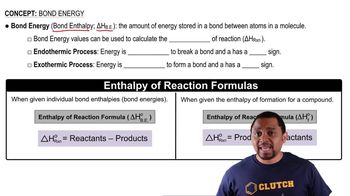
Determine the enthalpy change (∆H) for the reaction using the formula: ∆H = Total energy for bonds broken - Total energy for bonds formed. Convert the result from kJ to kcal if needed (1 kcal = 4.184 kJ).

Risposta video verificata per un problema simile:

Questa soluzione video è stata consigliata dai nostri tutor come utile per risolvere questo problema.
Durata del video:
11m

Concetti chiave

Ecco i concetti essenziali che devi comprendere per rispondere correttamente alla domanda.

Bond Energies

Bond energies represent the amount of energy required to break a bond between two atoms in a molecule. In the context of chemical reactions, these values are crucial for calculating the overall energy change (∆H) during the reaction. By summing the bond energies of the reactants and subtracting the bond energies of the products, one can estimate the enthalpy change associated with the reaction.
Video consigliato:

Enthalpy Change (∆H)

Enthalpy change (∆H) is a measure of the heat content of a system at constant pressure. It indicates whether a reaction is exothermic (releases heat, ∆H < 0) or endothermic (absorbs heat, ∆H > 0). Calculating ∆H using bond energies allows chemists to predict the energy dynamics of a reaction, which is essential for understanding reaction feasibility and conditions.
Video consigliato:
Percorso guidato
01:17
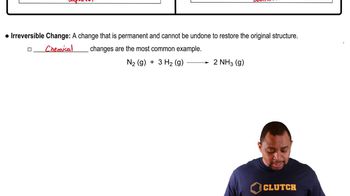
Physical & Chemical Changes

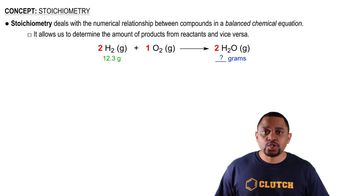
Stoichiometry of the Reaction

Stoichiometry involves the quantitative relationships between the reactants and products in a chemical reaction. In the given reaction, the coefficients indicate the molar ratios of nitrogen and oxygen reacting to form nitrogen dioxide. Understanding stoichiometry is vital for accurately applying bond energies and calculating the total energy change, as it ensures that the correct number of bonds is considered in the energy calculations.
Video consigliato: