Ch.7 Chemical Reactions: Energy, Rate and Equilibrium
McMurry - Fundamentals of General, Organic, and Biological Chemistry 8th Edition
McMurry8th EditionFundamentals of General, Organic, and Biological ChemistryISBN: 9780134015187Non è quello che usi tu?Cambia libro di testo
Capitolo 7, Problema 59b

Oxygen can be converted into ozone by the action of lightning or electric sparks:
3 O2(g) ⇌ 2 O3(g)
For this reaction, ∆H = +69kcal/mol (+285 kj/mol) and K = 2.68 × 10⁻²⁹ at 25 °C.
b. Are the reactants or the products favored at equilibrium?

Guida verificata passo dopo passo
1
Step 1: Analyze the equilibrium constant (K). The equilibrium constant (K) indicates the ratio of the concentrations of products to reactants at equilibrium. A very small K value (e.g., 2.68 x 10^-29) suggests that the concentration of products is much smaller than the concentration of reactants at equilibrium.
Step 2: Interpret the given K value. Since K is extremely small, the reaction heavily favors the reactants at equilibrium, meaning that the formation of ozone (O3) is not favored under these conditions.
Step 3: Consider the enthalpy change (∆H). The reaction has a positive ∆H value (+69 kcal/mol), indicating that it is endothermic. This means the reaction requires energy input (e.g., from lightning or electric sparks) to proceed toward the formation of ozone.
Step 4: Relate ∆H to temperature. For an endothermic reaction, increasing the temperature would favor the formation of products (O3) because the system absorbs heat. However, at 25 °C, the reaction still strongly favors the reactants due to the very small K value.
Step 5: Conclude the equilibrium position. At 25 °C, the reactants (O2) are heavily favored at equilibrium because the equilibrium constant (K) is extremely small, indicating that only a negligible amount of ozone (O3) is formed under these conditions.

Risposta video verificata per un problema simile:

Questa soluzione video è stata consigliata dai nostri tutor come utile per risolvere questo problema.
Durata del video:
1m

Concetti chiave

Ecco i concetti essenziali che devi comprendere per rispondere correttamente alla domanda.

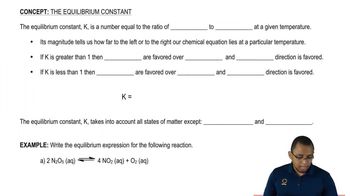
Equilibrium Constant (K)

The equilibrium constant (K) quantifies the ratio of the concentrations of products to reactants at equilibrium for a given reaction at a specific temperature. A small K value, such as 2.68 x 10^-29, indicates that at equilibrium, the concentration of reactants is much greater than that of products, suggesting that the reaction favors the reactants.
Video consigliato:
Percorso guidato
02:50
The Equilibrium Constant Concept 1

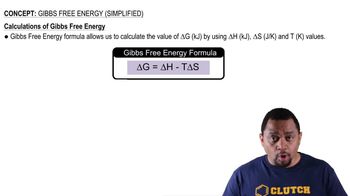
Gibbs Free Energy (∆G)

Gibbs Free Energy (∆G) is a thermodynamic potential that helps predict the direction of a chemical reaction. It is related to the enthalpy change (∆H) and entropy change (∆S) of the system. A positive ∆H, as given in the question, typically indicates that the reaction is endothermic, which can also suggest that the formation of products is less favorable under standard conditions.
Video consigliato:
Percorso guidato
01:04
Gibbs Free Energy (Simplified) Concept 3

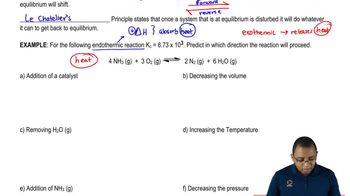
Le Chatelier's Principle

Le Chatelier's Principle states that if a dynamic equilibrium is disturbed by changing the conditions, the system will adjust to counteract the change and restore a new equilibrium. In this context, understanding how changes in temperature, pressure, or concentration affect the position of equilibrium can help predict whether reactants or products will be favored.
Video consigliato:
Percorso guidato
09:34
The following is an endothermic reaction where Kc = 6.73 x 10³.For each of the choices below predict in which direction the reaction will proceed