Domanda del libro di testo
Is the total enthalpy (H) of the reactants for an endothermic reaction greater than or less than the total enthalpy of the products?
2176
views

 McMurry 8th EditionCh.7 Chemical Reactions: Energy, Rate and EquilibriumProblema 22b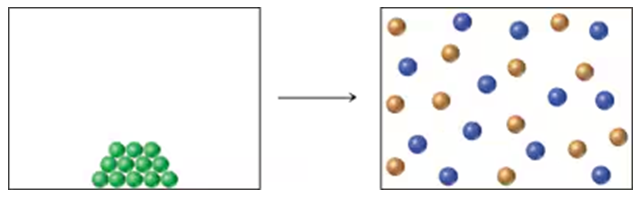
 Guida verificata passo dopo passo
 02:32
02:32
 06:17
06:17 03:22
03:22Is the total enthalpy (H) of the reactants for an endothermic reaction greater than or less than the total enthalpy of the products?
The vaporization of Br2 from the liquid to the gas state requires 7.4 kcal/mol (31.0 kJ/mol).
c. How many kilojoules are needed to evaporate 82 g of Br2?
What effect do the listed changes have on the position of the equilibrium in the reaction of carbon with hydrogen?
C(s) + 2 H2(g) ⇌ CH4(g) ∆H = -18 kcal/mol (-75kJ/mol)
c. Allowing CH4 to escape continuously from the reaction vessel
The vaporization of Br2 from the liquid to the gas state requires 7.4 kcal/mol (31.0 kJ/mol).
a. What is the sign of ∆H for this process? Write a reaction showing heat as a product or reactant.
Two curves are shown in the following energy diagram:
b. Which curve represents the spontaneous reaction, and which the nonspontaneous?
The following diagram portrays a reaction of the type A(s) → B(g) + C(g), where the different-colored spheres represent different molecular structures. Assume that the reaction has ∆H = +9.1 kcal/mol (+38.1 kJ/mol).
a. What is the sign of ∆S for the reaction?