Domanda del libro di testo
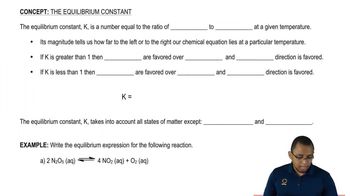
The following diagrams represent two similar reactions that have achieved equilibrium:
<IMAGE>
a. Write the expression for the equilibrium constant for each reaction.
1760
views

 McMurry 8th EditionCh.7 Chemical Reactions: Energy, Rate and EquilibriumProblema 14b
 Guida verificata passo dopo passo
 02:50
02:50
 03:42
03:42 01:16
01:16The following diagrams represent two similar reactions that have achieved equilibrium:
<IMAGE>
a. Write the expression for the equilibrium constant for each reaction.
What effect do the listed changes have on the position of the equilibrium in the reaction of carbon with hydrogen?
C(s) + 2 H2(g) ⇌ CH4(g) ∆H = -18 kcal/mol (-75kJ/mol)
b. Increasing pressure by decreasing volume
Do the following reactions favor reactants or products at equilibrium? Give relative concentrations at equilibrium.
a. Sucrose(aq) + H2O(l) ⇌ Glucose(aq) + Fructose(aq) K = 1.4 × 10⁵
Do the following reactions favor reactants or products at equilibrium? Give relative concentrations at equilibrium.
c. Fe2O3(s) + 3 CO(g) ⇌ 2 Fe(s) + 3 CO2(g) K (at 727 °C) = 24.2
What effect do the listed changes have on the position of the equilibrium in the reaction of carbon with hydrogen?
C(s) + 2 H2(g) ⇌ CH4(g) ∆H = -18 kcal/mol (-75kJ/mol)
a. Increasing temperature
Is the yield of SO3 at equilibrium favored by a higher or lower pressure? By a higher or lower temperature?
2 SO2(g) + O2 ⇌ 2 SO3(g) ∆H = -47 kcal/mol