
Ch.7 Chemical Reactions: Energy, Rate and Equilibrium
McMurry - Fundamentals of General, Organic, and Biological Chemistry 8th Edition
McMurry8th EditionFundamentals of General, Organic, and Biological ChemistryISBN: 9780134015187Non è quello che usi tu?Cambia libro di testo
Capitolo 7, Problema 65c

The reaction H2(g) + I2(g) ⇌ 2 HI(g) has ∆H = -2.2 kcal/mol (-9.2 kJ/mol). Will the equilibrium concentration of HI increase or decrease when
c. A catalyst is added?

Guida verificata passo dopo passo
1
Understand the role of a catalyst: A catalyst speeds up the rate of a chemical reaction by lowering the activation energy, but it does not affect the position of equilibrium or the concentrations of reactants and products at equilibrium.
Recall Le Chatelier's Principle: This principle states that if a system at equilibrium is disturbed, the system will adjust to minimize the disturbance and re-establish equilibrium. However, adding a catalyst does not count as a disturbance to the equilibrium conditions.
Analyze the effect of the catalyst: Since a catalyst does not change the ∆H (enthalpy change) of the reaction or the equilibrium constant (K), it will not alter the equilibrium concentrations of H₂, I₂, or HI.
Conclude the impact on HI concentration: Adding a catalyst will not increase or decrease the equilibrium concentration of HI. It will only allow the system to reach equilibrium faster if it is not already at equilibrium.
Summarize: The equilibrium concentration of HI will remain unchanged when a catalyst is added.

Risposta video verificata per un problema simile:

Questa soluzione video è stata consigliata dai nostri tutor come utile per risolvere questo problema.
Durata del video:
1m

Concetti chiave

Ecco i concetti essenziali che devi comprendere per rispondere correttamente alla domanda.

Chemical Equilibrium

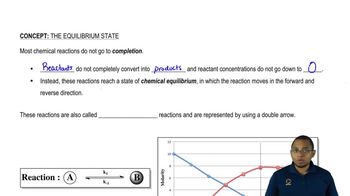
Chemical equilibrium occurs when the rates of the forward and reverse reactions are equal, resulting in constant concentrations of reactants and products. In the given reaction, H2 and I2 combine to form HI, and the system can shift in response to changes in conditions, such as concentration, temperature, or pressure.
Video consigliato:
Percorso guidato
03:42
Chemical Equilibrium Concept 1

Catalysts

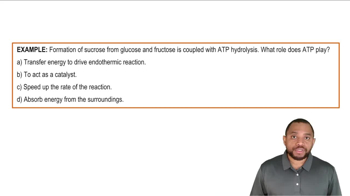
A catalyst is a substance that increases the rate of a chemical reaction without being consumed in the process. It works by lowering the activation energy required for the reaction to occur. Importantly, while catalysts speed up the attainment of equilibrium, they do not change the position of the equilibrium itself or the concentrations of reactants and products at equilibrium.
Video consigliato:
Percorso guidato
1:17
Coupled Reactions Example 3

Le Chatelier's Principle

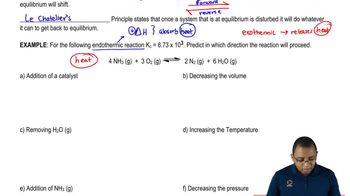
Le Chatelier's Principle states that if a dynamic equilibrium is disturbed by changing the conditions, the system will adjust to counteract the change and restore a new equilibrium. In the context of the reaction provided, adding a catalyst does not disturb the equilibrium concentrations of H2, I2, or HI, meaning the equilibrium position remains unchanged.
Video consigliato:
Percorso guidato
09:34
The following is an endothermic reaction where Kc = 6.73 x 10³.For each of the choices below predict in which direction the reaction will proceed