Ch.8 Gases, Liquids and Solids
McMurry - Fundamentals of General, Organic, and Biological Chemistry 8th Edition
McMurry8th EditionFundamentals of General, Organic, and Biological ChemistryISBN: 9780134015187Non è quello che usi tu?Cambia libro di testo
Capitolo 8, Problema 47

Which assumptions of the kinetic–molecular theory explain the behavior of gases described by Boyle's law? Explain your answer.

Guida verificata passo dopo passo
1
Boyle's law states that the pressure of a gas is inversely proportional to its volume at constant temperature. This relationship can be expressed mathematically as: P⁢∝ 1V, or equivalently, P1V1 = P2V2.
The kinetic–molecular theory (KMT) explains the behavior of gases by making several assumptions. One key assumption is that gas particles are in constant, random motion and collide elastically with the walls of their container, creating pressure.
Another assumption of KMT is that the volume of the gas particles themselves is negligible compared to the volume of the container. This allows the gas to expand or compress freely, which is essential for Boyle's law to hold true.
When the volume of a gas decreases (at constant temperature), the gas particles have less space to move, leading to more frequent collisions with the container walls. According to KMT, this increase in collision frequency results in an increase in pressure, consistent with Boyle's law.
Conversely, when the volume increases, the gas particles have more space to move, leading to fewer collisions with the container walls and a decrease in pressure. This behavior aligns with the inverse relationship between pressure and volume described by Boyle's law.

Risposta video verificata per un problema simile:

Questa soluzione video è stata consigliata dai nostri tutor come utile per risolvere questo problema.
Durata del video:
5m

Concetti chiave

Ecco i concetti essenziali che devi comprendere per rispondere correttamente alla domanda.

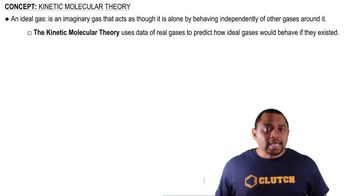
Kinetic-Molecular Theory

The kinetic-molecular theory posits that gases consist of a large number of small particles in constant, random motion. This theory explains gas behavior by relating temperature to the average kinetic energy of the particles, emphasizing that gas particles are far apart and interact minimally, which is crucial for understanding gas laws.
Video consigliato:
Percorso guidato
01:19
Kinetic Molecular Theory Concept 1

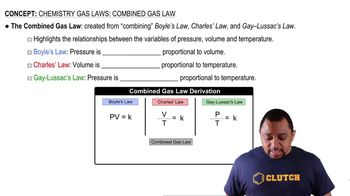
Boyle's Law

Boyle's law states that the pressure of a gas is inversely proportional to its volume when temperature is held constant. This means that as the volume of a gas decreases, its pressure increases, which can be explained by the kinetic-molecular theory, as reduced volume leads to more frequent collisions of gas particles with the walls of the container.
Video consigliato:
Percorso guidato
01:43
Chemistry Gas Laws: Combined Gas Law

Assumptions of Gas Behavior

Key assumptions of gas behavior include that gas particles are in constant motion, occupy negligible volume, and experience elastic collisions. These assumptions help explain how changes in volume affect pressure, as they imply that the frequency and force of collisions increase when volume decreases, aligning with Boyle's law.
Video consigliato:
Percorso guidato
01:15
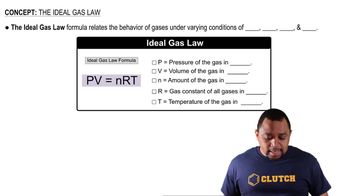
The Ideal Gas Law Concept 1