Ch.8 Gases, Liquids and Solids
McMurry - Fundamentals of General, Organic, and Biological Chemistry 8th Edition
McMurry8th EditionFundamentals of General, Organic, and Biological ChemistryISBN: 9780134015187Non è quello che usi tu?Cambia libro di testo
Capitolo 8, Problema 78

Which sample contains more molecules: 2.0 L of Cl2 at STP or 3.0 L of CH4 at 300 K and 1150 mmHg? Which sample weighs more?

Guida verificata passo dopo passo
1
Determine the number of molecules in each sample using the ideal gas law. Start with the sample of Cl₂ at STP. At STP (Standard Temperature and Pressure), 1 mole of any gas occupies 22.4 L. Use the relationship: \( \text{moles of Cl}_2 = \frac{\text{volume of Cl}_2}{22.4 \text{ L/mol}} \). Then, calculate the number of molecules by multiplying the moles by Avogadro's number \( (6.022 \times 10^{23} \text{ molecules/mol}) \).
For the CH₄ sample, use the ideal gas law \( PV = nRT \) to calculate the number of moles. Rearrange the equation to solve for \( n \): \( n = \frac{PV}{RT} \). Convert the pressure from mmHg to atm using the conversion factor \( 1 \text{ atm} = 760 \text{ mmHg} \). Use \( R = 0.0821 \text{ L·atm/(mol·K)} \) and substitute the given values for pressure, volume, and temperature to find \( n \). Then, calculate the number of molecules by multiplying \( n \) by Avogadro's number.
Compare the number of molecules in the Cl₂ sample and the CH₄ sample to determine which contains more molecules.
To determine which sample weighs more, calculate the mass of each sample. For Cl₂, use the molar mass of Cl₂ (\( 70.90 \text{ g/mol} \)) and multiply it by the number of moles of Cl₂ calculated earlier. For CH₄, use the molar mass of CH₄ (\( 16.04 \text{ g/mol} \)) and multiply it by the number of moles of CH₄ calculated earlier.
Compare the masses of the Cl₂ sample and the CH₄ sample to determine which weighs more.

Risposta video verificata per un problema simile:

Questa soluzione video è stata consigliata dai nostri tutor come utile per risolvere questo problema.
Durata del video:
3m

Concetti chiave

Ecco i concetti essenziali che devi comprendere per rispondere correttamente alla domanda.

Avogadro's Law

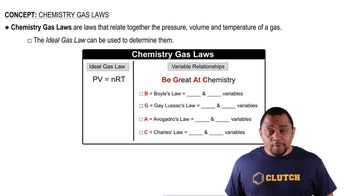
Avogadro's Law states that equal volumes of gases, at the same temperature and pressure, contain an equal number of molecules. This principle allows us to compare the number of molecules in different gas samples by considering their volumes under standard conditions, such as STP (Standard Temperature and Pressure).
Video consigliato:
Percorso guidato
00:58
Chemistry Gas Laws Concept 1

Ideal Gas Law

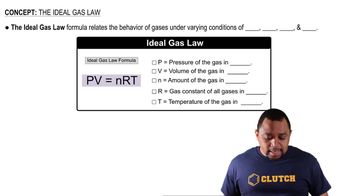
The Ideal Gas Law (PV = nRT) relates the pressure (P), volume (V), temperature (T), and number of moles (n) of a gas. This law can be used to calculate the number of moles of CH₄ at the given conditions (300 K and 1150 mmHg) to determine how many molecules are present in that sample.
Video consigliato:
Percorso guidato
01:15
The Ideal Gas Law Concept 1

Molar Mass

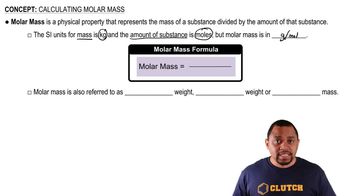
Molar mass is the mass of one mole of a substance, typically expressed in grams per mole (g/mol). To compare the weights of the two gas samples, we can calculate the mass of each gas using their respective molar masses (Cl₂ = 70.9 g/mol and CH₄ = 16.04 g/mol) and the number of moles derived from the Ideal Gas Law.
Video consigliato:
Percorso guidato
01:10
Calculating Molar Mass