Ch.9 Solutions
McMurry - Fundamentals of General, Organic, and Biological Chemistry 8th Edition
McMurry8th EditionFundamentals of General, Organic, and Biological ChemistryISBN: 9780134015187Non è quello che usi tu?Cambia libro di testo
Capitolo 9, Problema 26a

A typical oral rehydration solution (ORS) for infants contains 90 mEq/L Na+ , 20 mEq/L K+ , 110 mEq/L Cl- , and 2.0% (m/v) glucose (MW = 180g/mol)
a. Calculate the concentration of each ORS component in units of molarity.

Guida verificata passo dopo passo
1
Step 1: Understand the problem. Molarity (M) is defined as moles of solute per liter of solution. To calculate the molarity of each component, we need to convert the given concentrations (mEq/L for ions and % (m/v) for glucose) into moles per liter (mol/L).
Step 2: Convert the concentrations of Na⁺, K⁺, and Cl⁻ from mEq/L to mol/L. Use the relationship: 1 mEq = 1 × 10⁻³ mol for monovalent ions. For example, for Na⁺: \( \text{Molarity of Na⁺} = \frac{90 \text{ mEq/L}}{1000} \). Repeat this for K⁺ and Cl⁻ using their respective mEq/L values.
Step 3: Convert the glucose concentration from % (m/v) to mol/L. A 2.0% (m/v) solution means 2.0 g of glucose is dissolved in 100 mL of solution. First, convert grams to moles using the molar mass of glucose (180 g/mol): \( \text{Moles of glucose} = \frac{2.0 \text{ g}}{180 \text{ g/mol}} \). Then, convert the volume from mL to L (100 mL = 0.1 L) and calculate molarity: \( \text{Molarity of glucose} = \frac{\text{Moles of glucose}}{0.1 \text{ L}} \).
Step 4: Summarize the molarity calculations for each component. For Na⁺, K⁺, and Cl⁻, the molarity is directly obtained from the mEq/L conversion. For glucose, the molarity is obtained from the % (m/v) conversion.
Step 5: Double-check the units and ensure all concentrations are expressed in mol/L. This ensures consistency and correctness in the final results.

Risposta video verificata per un problema simile:

Questa soluzione video è stata consigliata dai nostri tutor come utile per risolvere questo problema.
Durata del video:
7m

Concetti chiave

Ecco i concetti essenziali che devi comprendere per rispondere correttamente alla domanda.

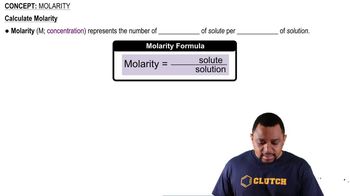
Molarity

Molarity is a measure of concentration defined as the number of moles of solute per liter of solution. It is expressed in moles per liter (mol/L). To calculate molarity, one must know the amount of solute in moles and the volume of the solution in liters. This concept is essential for converting the given milliequivalents per liter (mEq/L) of ions into molarity.
Video consigliato:

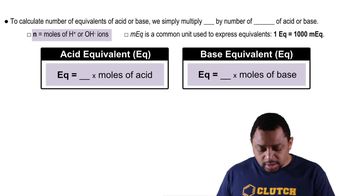
Milliequivalents

Milliequivalents (mEq) are a unit of measure that expresses the amount of a substance based on its chemical activity or reactivity, particularly in relation to ions. One milliequivalent is equivalent to one-thousandth of an equivalent, which is the amount of a substance that can combine with or displace one mole of hydrogen ions. Understanding this concept is crucial for converting the given concentrations of Na⁺, K⁺, and Cl⁻ into molarity.
Video consigliato:
Percorso guidato
00:46
Acid-Base Equivalents Concept 2

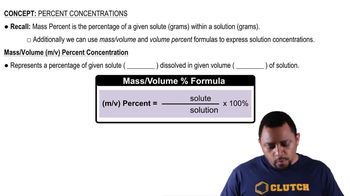
Glucose Concentration

The concentration of glucose in an oral rehydration solution is typically expressed as a percentage by mass/volume (m/v). In this case, a 2.0% (m/v) glucose solution means there are 2 grams of glucose in 100 mL of solution. To convert this to molarity, one must calculate the number of moles of glucose using its molecular weight (180 g/mol) and then divide by the volume of the solution in liters.
Video consigliato:
Percorso guidato
00:52
Percent Concentrations Concept 1