
Ch.9 Solutions
McMurry - Fundamentals of General, Organic, and Biological Chemistry 8th Edition
McMurry8th EditionFundamentals of General, Organic, and Biological ChemistryISBN: 9780134015187Non è quello che usi tu?Cambia libro di testo
Capitolo 9, Problema 84

An isotonic solution must be approximately 0.30 osmol/L. How much KCl is needed to prepare 175 mL of an isotonic solution?

Guida verificata passo dopo passo
1
Step 1: Understand the concept of isotonic solutions. An isotonic solution has the same osmolarity as body fluids, which is approximately 0.30 osmol/L. Osmolarity is the total concentration of solute particles in a solution.
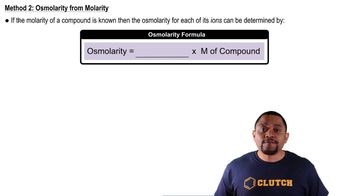
Step 2: Recognize that potassium chloride (KCl) dissociates completely in water into two ions: K⁺ and Cl⁻. Therefore, 1 mole of KCl produces 2 osmoles of particles. This means the osmolarity of the solution is twice the molarity of KCl.
Step 3: Use the formula for osmolarity: \( \text{Osmolarity} = \text{Molarity} \times \text{Number of particles per formula unit} \). Rearrange the formula to solve for molarity: \( \text{Molarity} = \frac{\text{Osmolarity}}{\text{Number of particles per formula unit}} \). Substitute \( \text{Osmolarity} = 0.30 \; \text{osmol/L} \) and \( \text{Number of particles per formula unit} = 2 \).
Step 4: Calculate the number of moles of KCl needed using the molarity formula: \( \text{Molarity} = \frac{\text{moles of solute}}{\text{volume of solution in liters}} \). Rearrange to solve for moles: \( \text{moles of solute} = \text{Molarity} \times \text{volume of solution in liters} \). Convert 175 mL to liters by dividing by 1000.
Step 5: Convert the moles of KCl to grams using the molar mass of KCl. The molar mass of KCl is approximately 74.55 g/mol. Use the formula: \( \text{mass of KCl} = \text{moles of KCl} \times \text{molar mass of KCl} \).

Risposta video verificata per un problema simile:

Questa soluzione video è stata consigliata dai nostri tutor come utile per risolvere questo problema.
Durata del video:
5m

Concetti chiave

Ecco i concetti essenziali che devi comprendere per rispondere correttamente alla domanda.

Osmolarity

Osmolarity is a measure of the total concentration of solute particles in a solution. It is expressed in osmoles per liter (osmol/L) and is crucial for understanding how solutions affect cell volume and function. An isotonic solution has the same osmolarity as body fluids, preventing net movement of water across cell membranes.
Video consigliato:

Isotonic Solutions

An isotonic solution is one that has the same osmotic pressure as another solution, typically bodily fluids. This means that when cells are placed in an isotonic solution, there is no net movement of water into or out of the cells, maintaining their shape and function. For human cells, an isotonic solution is approximately 0.30 osmol/L.
Video consigliato:

KCl Preparation

Potassium chloride (KCl) is often used to create isotonic solutions in laboratory settings. To prepare a specific osmolarity, one must calculate the amount of KCl needed based on its dissociation in solution. KCl dissociates into potassium (K+) and chloride (Cl-) ions, contributing to the total osmolarity, which must be considered when preparing the solution.
Video consigliato:
Percorso guidato
01:13
Entropy (Simplified) Example 2