
Domanda del libro di testo
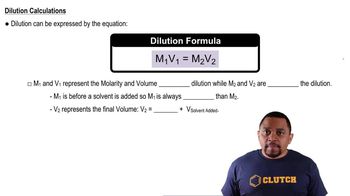
The concentration of cholesterol (C27H46O) in blood is approximately 5.0 mM. How many grams of cholesterol are in 250 mL of blood?
2465
views

 Guida verificata passo dopo passo
 00:58
00:58
 01:38
01:38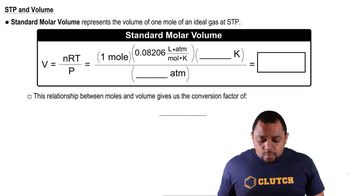 01:21
01:21The concentration of cholesterol (C27H46O) in blood is approximately 5.0 mM. How many grams of cholesterol are in 250 mL of blood?
The diagram to the right shows plots of vapor pressure versus temperature for a solvent and a solution.
b. What is the approximate boiling-point elevation for the solution?
<IMAGE>
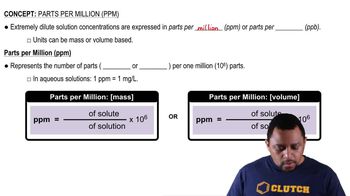
The maximum amounts of lead and copper allowed in drinking water are 0.015 mg/kg for lead and 1.3 mg/kg for copper. Express these values in parts per million, and tell the maximum amount of each (in grams) allowed in 100 g of water.
When 1.0 mol of HF is dissolved in 1.0 kg of water, the boiling point of the resulting solution is 100.5 °C. Is HF a strong or weak electrolyte? Explain.
At a total atmospheric pressure of 1.00 atm, the partial pressure of CO2 in air is approximately 4.0 × 10⁻⁴atm. Using the data in Problem 9.4, what is the solubility of CO2 in an open bottle of seltzer water at 20 °C?
The typical concentration of Mg2+ in blood is 3 mEq/L. How many milligrams of Mg2+ are in 250 mL of blood?