Ch.9 Solutions
McMurry - Fundamentals of General, Organic, and Biological Chemistry 8th Edition
McMurry8th EditionFundamentals of General, Organic, and Biological ChemistryISBN: 9780134015187Non è quello che usi tu?Cambia libro di testo
Capitolo 9, Problema 35

Why does water not dissolve motor oil?

Guida verificata passo dopo passo
1
Understand the principle of solubility: 'Like dissolves like.' This means that polar substances dissolve in polar solvents, and nonpolar substances dissolve in nonpolar solvents.
Recognize that water is a polar molecule. Its polarity arises from the difference in electronegativity between hydrogen and oxygen atoms, creating a partial positive charge on hydrogen and a partial negative charge on oxygen.
Identify that motor oil is a nonpolar substance. Motor oil consists of long hydrocarbon chains, which lack significant electronegativity differences and do not form dipoles.
Explain that polar molecules like water cannot effectively interact with nonpolar molecules like motor oil. Water molecules are strongly attracted to each other through hydrogen bonding, and they do not form similar interactions with nonpolar molecules.
Conclude that because water and motor oil have different polarities, they are immiscible, meaning they do not mix or dissolve in each other.

Risposta video verificata per un problema simile:

Questa soluzione video è stata consigliata dai nostri tutor come utile per risolvere questo problema.
Durata del video:
4m

Concetti chiave

Ecco i concetti essenziali che devi comprendere per rispondere correttamente alla domanda.

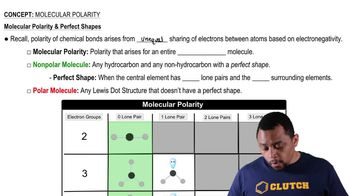
Polarity

Polarity refers to the distribution of electrical charge over the atoms in a molecule. Water is a polar molecule, meaning it has a partial positive charge on one side and a partial negative charge on the other. This polarity allows water to form hydrogen bonds and interact effectively with other polar substances, but it does not interact well with non-polar substances like motor oil.
Video consigliato:
Percorso guidato
01:34
Molecular Polarity (Simplified) Concept 1

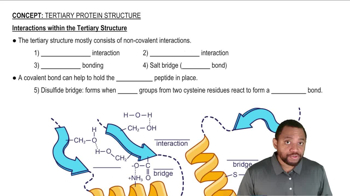
Hydrophobic and Hydrophilic Interactions

Hydrophobic interactions occur between non-polar substances that repel water, while hydrophilic interactions occur between polar substances that attract water. Motor oil is hydrophobic, meaning it does not mix with water. This is because the non-polar molecules in motor oil do not form favorable interactions with the polar water molecules, leading to separation rather than dissolution.
Video consigliato:
Percorso guidato
2:41
Interactions within the Tertiary Structure Concept 2

Solubility Principles

Solubility is the ability of a substance to dissolve in a solvent, which is influenced by the nature of both the solute and the solvent. The principle 'like dissolves like' suggests that polar solvents dissolve polar solutes, and non-polar solvents dissolve non-polar solutes. Since water is polar and motor oil is non-polar, they do not dissolve in each other, illustrating this principle.
Video consigliato:
Percorso guidato
00:28
Solubility Rules
Pratica correlata
Domanda del libro di testo

The solubility of NH3 gas in water at an NH₃ pressure of 760.0 mmHg and 25°C is 51.8 g/100 mL and 27.0 g/100 mL at 50°C.

a.What is the solubility of NH3 if its partial pressure is reduced to 225.0 mmHg?

1755
views

Domanda del libro di testo

How can you tell a solution from a colloid?

2936
views
Domanda del libro di testo

The solubility of CO2 gas in water is 0.15 g/100 mL at a CO2 pressure of 760 mmHg.

b. An atmospheric concentration of 380 ppm, CO2 corresponds to a partial pressure of 0.00038 atm. What percentage of the CO2 originally dissolved in the solution in part (a) remains in solution after the soft drink reaches equilibrium with the ambient atmosphere?

1122
views
Domanda del libro di testo

The solubility of NH3 gas in water at an NH3 pressure of 760.0 mmHg and 25°C is 51.8 g/100 mL and 27.0 g/100 mL at 50°C.

b. How many moles of NH3 would be released from 1.0 L of a saturated NH3 solution if the temperature was increased from 25 to 50 °C?

1759
views
Domanda del libro di testo

HF is a weak electrolyte and HBr is a strong electrolyte. Which of the curves in the figure represents the change in the boiling point of an aqueous solution when 1 mole of HF is added to 1 kg of water, and which represents the change when 1 mol of HBr is added?

<IMAGE>

3713
views
Domanda del libro di testo

When 1 mol of HCl is added to 1 kg of water, the boiling point increases by 1.0 °C, but when 1 mol of acetic acid, CH3CO2H is added to 1 kg of water, the boiling point increases by only 0.5 °C. Explain.

2863
views