Ch.12 Introduction to Organic Chemistry: Alkanes
McMurry - Fundamentals of General, Organic, and Biological Chemistry 8th Edition
McMurry8th EditionFundamentals of General, Organic, and Biological ChemistryISBN: 9780134015187Non è quello che usi tu?Cambia libro di testo
Capitolo 12, Problema 75b

How many hydrogen atoms are needed to complete the hydrocarbon formulas for the following carbon backbones?
b. <IMAGE>

Guida verificata passo dopo passo
1
Identify the type of hydrocarbon (alkane, alkene, or alkyne) based on the carbon backbone provided. Alkanes have single bonds, alkenes have at least one double bond, and alkynes have at least one triple bond.
Use the general formula for the type of hydrocarbon to determine the number of hydrogen atoms. For alkanes, the formula is CnH2n+2; for alkenes, it is CnH2n; and for alkynes, it is CnH2n-2.
Count the number of carbon atoms (n) in the given carbon backbone. This will be used in the formula to calculate the number of hydrogen atoms.
Subtract any hydrogen atoms already present in the structure from the total number of hydrogen atoms calculated using the formula. This will give the number of additional hydrogen atoms needed.
Verify the structure to ensure that each carbon atom forms four bonds (following the octet rule) and that the total number of hydrogen atoms matches the calculated value.

Risposta video verificata per un problema simile:

Questa soluzione video è stata consigliata dai nostri tutor come utile per risolvere questo problema.

Concetti chiave

Ecco i concetti essenziali che devi comprendere per rispondere correttamente alla domanda.

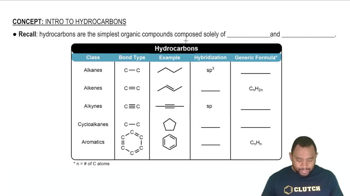
Hydrocarbons

Hydrocarbons are organic compounds consisting entirely of hydrogen and carbon atoms. They can be classified into aliphatic (straight or branched chains) and aromatic (ring structures) types. Understanding the structure of hydrocarbons is essential for determining how many hydrogen atoms are needed to satisfy the tetravalency of carbon, which forms four bonds.
Video consigliato:
Percorso guidato
4:29
Intro to Hydrocarbons Concept 1

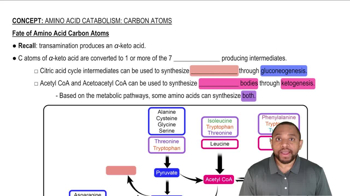
Tetravalency of Carbon

Carbon has a tetravalent nature, meaning it can form four covalent bonds with other atoms. This property is crucial in hydrocarbon chemistry, as it dictates how many hydrogen atoms can bond with a given carbon backbone. For each carbon atom in a hydrocarbon, the number of hydrogen atoms required depends on the number of bonds formed with other carbon atoms or functional groups.
Video consigliato:
Percorso guidato
5:36
Amino Acid Catabolism: Carbon Atoms Concept 2

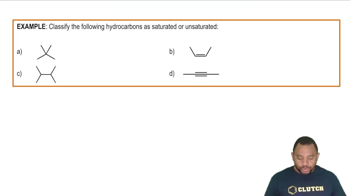
Saturation and Unsaturation

Saturation refers to hydrocarbons that contain only single bonds between carbon atoms, allowing for the maximum number of hydrogen atoms. Unsaturated hydrocarbons, on the other hand, contain double or triple bonds, which reduce the number of hydrogen atoms that can bond with the carbon backbone. Identifying whether a hydrocarbon is saturated or unsaturated is essential for calculating the required hydrogen atoms.
Video consigliato:
Percorso guidato
0:57
Saturated and Unsaturated Hydrocarbons Example 2