Ch.12 Introduction to Organic Chemistry: Alkanes
McMurry - Fundamentals of General, Organic, and Biological Chemistry 8th Edition
McMurry8th EditionFundamentals of General, Organic, and Biological ChemistryISBN: 9780134015187Non è quello che usi tu?Cambia libro di testo
Capitolo 12, Problema 52a

Write condensed structures for the following compounds:
a. 4-tert-Butyl-2-methylheptane

Guida verificata passo dopo passo
1
Identify the parent chain: The parent chain is the longest continuous chain of carbon atoms. In this case, the parent chain is 'heptane,' which consists of 7 carbon atoms.
Number the parent chain: Start numbering the carbon atoms in the parent chain from the end closest to the substituents to give the substituents the lowest possible numbers. Here, the substituents are at positions 2 and 4.
Identify the substituents: The substituents are a 'tert-butyl' group at carbon 4 and a 'methyl' group at carbon 2. A tert-butyl group is a branched group with the structure (C(CH₃)₃).
Write the condensed structure: Begin with the parent chain (heptane) and add the substituents at their respective positions. For example, at carbon 4, include the tert-butyl group, and at carbon 2, include the methyl group. Use parentheses to indicate branching.
Combine all components: The final condensed structure will represent the heptane chain with the tert-butyl group at position 4 and the methyl group at position 2. Ensure the structure is written in a clear and compact form, such as CH₃CH(CH₃)CH₂CH(C(CH₃)₃)CH₂CH₂CH₃.

Risposta video verificata per un problema simile:

Questa soluzione video è stata consigliata dai nostri tutor come utile per risolvere questo problema.

Concetti chiave

Ecco i concetti essenziali che devi comprendere per rispondere correttamente alla domanda.

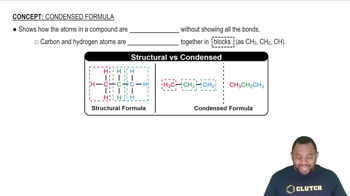
Condensed Structural Formula

A condensed structural formula is a way of representing a chemical compound that shows the arrangement of atoms in a molecule while omitting some of the bonds. It typically groups atoms together to indicate how they are connected, making it easier to visualize the structure without drawing every bond explicitly. For example, in a condensed formula, carbon atoms and their attached hydrogens are often written together, simplifying the representation.
Video consigliato:
Percorso guidato
1:53
Condensed Formula Concept 1

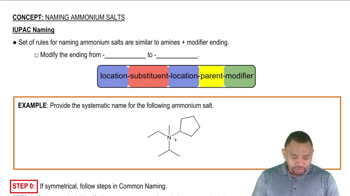
IUPAC Nomenclature

IUPAC nomenclature is a systematic method for naming chemical compounds, established by the International Union of Pure and Applied Chemistry. It provides rules for naming organic compounds based on their structure, including the identification of the longest carbon chain, substituents, and functional groups. Understanding IUPAC nomenclature is essential for accurately interpreting and writing chemical names, such as '4-tert-Butyl-2-methylheptane'.
Video consigliato:
Percorso guidato
3:18
IUPAC Naming Concept 3

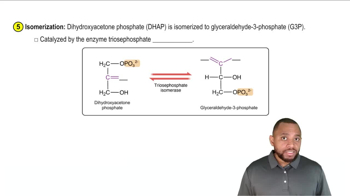
Isomerism

Isomerism refers to the phenomenon where two or more compounds have the same molecular formula but different structural arrangements or spatial orientations of atoms. In organic chemistry, isomers can differ in the connectivity of their atoms (structural isomers) or in the arrangement of their atoms in space (stereoisomers). Recognizing isomerism is crucial when analyzing compounds like 4-tert-Butyl-2-methylheptane, as it can lead to different physical and chemical properties.
Video consigliato:
Percorso guidato
1:26
Glycolysis Concept 5