Ch.12 Introduction to Organic Chemistry: Alkanes
McMurry - Fundamentals of General, Organic, and Biological Chemistry 8th Edition
McMurry8th EditionFundamentals of General, Organic, and Biological ChemistryISBN: 9780134015187Non è quello che usi tu?Cambia libro di testo
Capitolo 12, Problema 63

Write the formulas of the three doubly brominated isomers formed when 2-methylpropane reacts with Br2 in the presence of light.

Guida verificata passo dopo passo
1
Understand the reaction: The reaction involves the bromination of 2-methylpropane (C₄H₁₀) in the presence of light, which indicates a free radical halogenation mechanism. Bromine (Br₂) reacts with the hydrocarbon, replacing hydrogen atoms with bromine atoms.
Identify the structure of 2-methylpropane: The molecule has a central carbon atom bonded to three methyl groups (CH₃) and one hydrogen atom. Its structure is: CH₃-C(CH₃)₂-H.
Determine the possible positions for bromination: In 2-methylpropane, there are two types of hydrogen atoms: one primary hydrogen (on the CH₃ groups) and one tertiary hydrogen (on the central carbon). Bromination can occur at these positions.
Account for doubly brominated products: Since the problem asks for doubly brominated isomers, consider all combinations where two bromine atoms replace two hydrogens. These replacements can occur on the same carbon or on different carbons.
Write the formulas of the isomers: The three possible doubly brominated isomers are: (1) 1,1-dibromo-2-methylpropane (both bromines on the central carbon), (2) 1-bromo-2-bromo-2-methylpropane (one bromine on the central carbon and one on a methyl group), and (3) 2,2-dibromo-2-methylpropane (both bromines on the same methyl group).

Risposta video verificata per un problema simile:

Questa soluzione video è stata consigliata dai nostri tutor come utile per risolvere questo problema.

Concetti chiave

Ecco i concetti essenziali che devi comprendere per rispondere correttamente alla domanda.

Doubly Brominated Isomers

Doubly brominated isomers are organic compounds that contain two bromine atoms attached to different carbon atoms in a hydrocarbon chain. In the case of 2-methylpropane, the presence of multiple carbon atoms allows for various configurations where bromine can be substituted, leading to distinct isomers with different structural arrangements.
Video consigliato:
Percorso guidato
2:16
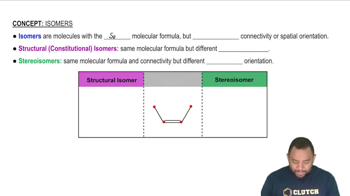
Isomers Concept 1

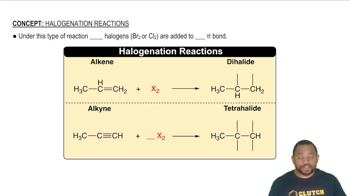
Radical Halogenation

Radical halogenation is a chemical reaction where alkanes react with halogens (like Br₂) in the presence of light or heat, resulting in the substitution of hydrogen atoms with halogen atoms. This process involves the formation of free radicals, which are highly reactive species that drive the substitution reactions, leading to the formation of various isomers.
Video consigliato:
Percorso guidato
1:11
Halogenation Reactions Concept 1

Structural Isomers

Structural isomers are compounds that have the same molecular formula but differ in the arrangement of atoms. In the context of the reaction of 2-methylpropane with Br₂, the different positions of bromine substitution on the carbon skeleton create distinct structural isomers, each with unique chemical properties despite having the same overall composition.
Video consigliato:
Percorso guidato
2:16
Isomers Concept 1