Ch.13 Alkenes, Alkynes, and Aromatic Compounds
McMurry - Fundamentals of General, Organic, and Biological Chemistry 8th Edition
McMurry8th EditionFundamentals of General, Organic, and Biological ChemistryISBN: 9780134015187Non è quello che usi tu?Cambia libro di testo
Capitolo 13, Problema 8b

Many biological transformations can be simply classified as additions, eliminations, or substitutions. How would you classify the following reactions?
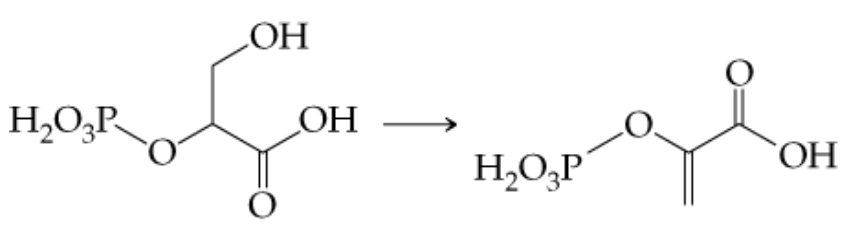
b. 2-Phosphoglyceric acid to phosphoenolpyruvic acid
Chemical reaction showing the conversion of 2-Phosphoglyceric acid to phosphoenolpyruvic acid with structural formulas.

Guida verificata passo dopo passo
1
Identify the type of reaction by analyzing the structural changes between the reactant (2-phosphoglyceric acid) and the product (phosphoenolpyruvic acid). Look for the addition or removal of atoms or groups, or the substitution of one group for another.
Observe that in this reaction, a water molecule (H₂O) is removed from the reactant. This is evident because the product contains a double bond (C=C) that was not present in the reactant.
Classify the reaction as an elimination reaction. Elimination reactions involve the removal of atoms or groups from a molecule, often resulting in the formation of a double bond or a ring structure.
Relate this reaction to its biological context in glycolysis. The conversion of 2-phosphoglyceric acid to phosphoenolpyruvic acid is catalyzed by the enzyme enolase, which facilitates the elimination of water.
Conclude that this reaction is an example of an elimination reaction, specifically a dehydration reaction, as it involves the removal of a water molecule.

Risposta video verificata per un problema simile:

Questa soluzione video è stata consigliata dai nostri tutor come utile per risolvere questo problema.

Concetti chiave

Ecco i concetti essenziali che devi comprendere per rispondere correttamente alla domanda.

Biological Transformations

Biological transformations refer to the chemical reactions that occur within living organisms, facilitating processes such as metabolism and energy production. These transformations can be categorized into three main types: additions, eliminations, and substitutions, which describe how molecules interact and change during biochemical pathways.
Video consigliato:
Percorso guidato
01:22
Alpha Decay Reaction Example

Glycolysis

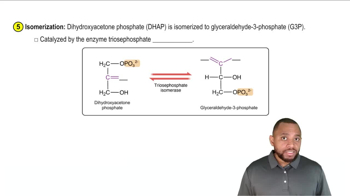
Glycolysis is a fundamental metabolic pathway that converts glucose into pyruvate, producing energy in the form of ATP. It consists of a series of enzymatic reactions, and understanding this pathway is crucial for analyzing the transformations of intermediates like 2-phosphoglyceric acid and phosphoenolpyruvic acid, which are key players in energy metabolism.
Video consigliato:
Percorso guidato
1:26
Glycolysis Concept 5

Enzyme Catalysis

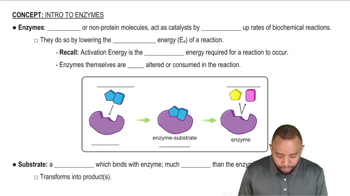
Enzyme catalysis is the process by which enzymes accelerate chemical reactions in biological systems. Enzymes lower the activation energy required for reactions, allowing transformations such as the conversion of 2-phosphoglyceric acid to phosphoenolpyruvic acid to occur efficiently under physiological conditions, which is essential for maintaining metabolic processes.
Video consigliato:
Percorso guidato
2:14
Intro to Enzymes Concept 1