Ch.14 Some Compounds with Oxygen, Sulfur, or a Halogen
McMurry - Fundamentals of General, Organic, and Biological Chemistry 8th Edition
McMurry8th EditionFundamentals of General, Organic, and Biological ChemistryISBN: 9780134015187Non è quello che usi tu?Cambia libro di testo
Capitolo 14, Problema 34b

Draw structures corresponding to the following names:
b. 2,2-Diethylcyclohexanol

Guida verificata passo dopo passo
1
Step 1: Understand the name of the compound. The name '2,2-Diethylcyclohexanol' can be broken down into three parts: (1) 'cyclohexanol' indicates a cyclohexane ring with an -OH (alcohol) group attached, (2) '2,2-' specifies that two substituents are attached to the second carbon of the ring, and (3) 'Diethyl' means there are two ethyl groups (-CH2CH3) as substituents.
Step 2: Draw the base structure of cyclohexanol. Start with a six-membered ring (cyclohexane) and add an -OH group to one of the carbons. Label this carbon as carbon-1.
Step 3: Identify carbon-2 on the cyclohexane ring. Moving clockwise or counterclockwise from carbon-1, label the adjacent carbon as carbon-2. This is where the two ethyl groups will be attached.
Step 4: Attach the two ethyl groups to carbon-2. Draw two -CH2CH3 groups bonded to carbon-2. Ensure that the geometry reflects the tetrahedral arrangement around carbon-2.
Step 5: Verify the structure. Confirm that the structure includes a cyclohexane ring, an -OH group on carbon-1, and two ethyl groups on carbon-2. Ensure all carbons have four bonds and the structure matches the IUPAC name.

Risposta video verificata per un problema simile:

Questa soluzione video è stata consigliata dai nostri tutor come utile per risolvere questo problema.

Concetti chiave

Ecco i concetti essenziali che devi comprendere per rispondere correttamente alla domanda.

Cyclohexanol

Cyclohexanol is a six-carbon cyclic alcohol with the molecular formula C6H12O. It features a hydroxyl (-OH) group attached to one of the carbon atoms in the cyclohexane ring. Understanding its structure is essential for drawing derivatives, as the position of substituents on the ring can significantly affect the compound's properties.
Video consigliato:
Percorso guidato
1:39
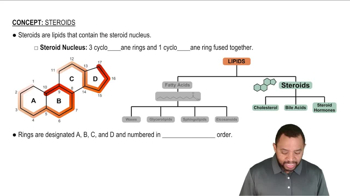
Steroids Concept 1

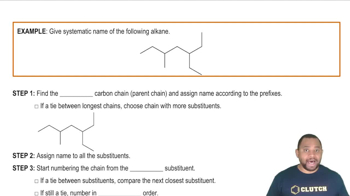
Substituents and Nomenclature

In organic chemistry, substituents are atoms or groups of atoms that replace hydrogen atoms in a hydrocarbon. The name '2,2-Diethylcyclohexanol' indicates that two ethyl groups are attached to the second carbon of the cyclohexanol ring. Familiarity with IUPAC nomenclature rules is crucial for accurately interpreting and drawing chemical structures.
Video consigliato:
Percorso guidato
5:07
Naming Alkanes with Substituents Example 1

Stereochemistry

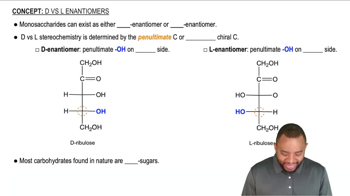
Stereochemistry involves the study of the spatial arrangement of atoms in molecules and how this affects their chemical behavior. In the case of 2,2-Diethylcyclohexanol, the arrangement of the ethyl groups around the cyclohexanol ring can lead to different stereoisomers. Recognizing the potential for stereoisomerism is important for understanding the compound's reactivity and interactions.
Video consigliato:
Percorso guidato
1:30
D vs L Enantiomers Concept 1