Ch.14 Some Compounds with Oxygen, Sulfur, or a Halogen
McMurry - Fundamentals of General, Organic, and Biological Chemistry 8th Edition
McMurry8th EditionFundamentals of General, Organic, and Biological ChemistryISBN: 9780134015187Non è quello che usi tu?Cambia libro di testo
Capitolo 14, Problema 11

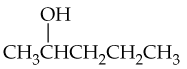
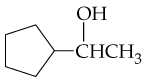
What products would you expect from oxidation of the following alcohols?
a. CH3CH2CH2OH
b.
c.

Guida verificata passo dopo passo
1
Step 1: Understand the concept of alcohol oxidation. Oxidation of alcohols involves the loss of hydrogen atoms or the gain of oxygen atoms. The product depends on the type of alcohol: primary, secondary, or tertiary.
Step 2: Analyze the structure of the first alcohol (CH3CH2CH2OH). This is a primary alcohol because the hydroxyl group (-OH) is attached to a carbon atom that is bonded to only one other carbon atom.
Step 3: Recall the oxidation pathway for primary alcohols. Primary alcohols are oxidized to aldehydes (R-CHO) first, and with further oxidation, they can form carboxylic acids (R-COOH). Determine the intermediate and final products for CH3CH2CH2OH.
Step 4: For parts b and c, examine the provided images to identify the type of alcohol (primary, secondary, or tertiary). Secondary alcohols oxidize to ketones (R-CO-R'), while tertiary alcohols generally do not undergo oxidation under normal conditions because they lack a hydrogen atom on the carbon bonded to the -OH group.
Step 5: Write the balanced chemical equations for the oxidation reactions of each alcohol, showing the reactants, products, and any required oxidizing agents (e.g., [O] or KMnO4). Ensure the equations reflect the correct products based on the type of alcohol.

Risposta video verificata per un problema simile:

Questa soluzione video è stata consigliata dai nostri tutor come utile per risolvere questo problema.

Concetti chiave

Ecco i concetti essenziali che devi comprendere per rispondere correttamente alla domanda.

Oxidation of Alcohols

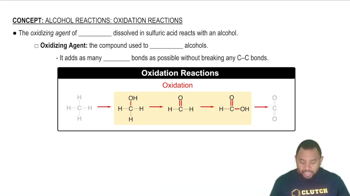
Oxidation of alcohols involves the conversion of alcohols into carbonyl compounds, such as aldehydes or ketones, and ultimately to carboxylic acids, depending on the type of alcohol and the oxidizing agent used. Primary alcohols typically oxidize to aldehydes, while secondary alcohols convert to ketones. Tertiary alcohols, however, do not oxidize easily due to the lack of a hydrogen atom on the carbon bearing the hydroxyl group.
Video consigliato:
Percorso guidato
1:49
Alcohol Reactions: Oxidation Concept 1

Types of Alcohols

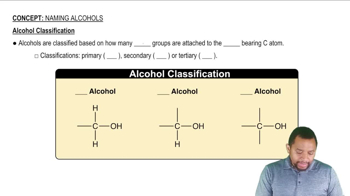
Alcohols are classified into three categories: primary, secondary, and tertiary, based on the number of carbon atoms attached to the carbon bearing the hydroxyl (-OH) group. Primary alcohols have one carbon attached, secondary alcohols have two, and tertiary alcohols have three. This classification is crucial for predicting the products of oxidation reactions, as the structure influences the oxidation pathway and final products.
Video consigliato:
Percorso guidato
1:10
Alcohol Classification Concept 2

Oxidizing Agents

Oxidizing agents are substances that facilitate the oxidation of other compounds by accepting electrons. Common oxidizing agents for alcohols include potassium dichromate (K2Cr2O7) and chromium trioxide (CrO3), which can convert alcohols into their corresponding carbonyl compounds. The choice of oxidizing agent can affect the reaction conditions and the specific products formed during the oxidation process.
Video consigliato:
Percorso guidato
1:49
Alcohol Reactions: Oxidation Concept 1