Ch.15 Aldehydes and Ketones
McMurry - Fundamentals of General, Organic, and Biological Chemistry 8th Edition
McMurry8th EditionFundamentals of General, Organic, and Biological ChemistryISBN: 9780134015187Non è quello che usi tu?Cambia libro di testo
Capitolo 15, Problema 51

Can the alcohol (CH3)3COH be formed by the reduction of an aldehyde or ketone? Why or why not?

Guida verificata passo dopo passo
1
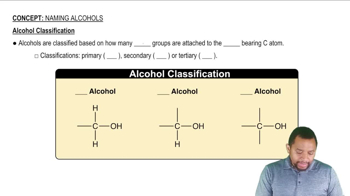
Identify the structure of the alcohol (CH3)3COH. This is a tertiary alcohol because the carbon atom bonded to the hydroxyl (-OH) group is also attached to three other carbon atoms.
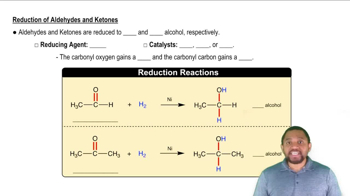
Understand the reduction process: Reduction of an aldehyde or ketone involves the addition of hydrogen (H2) to the carbonyl group (C=O), converting it into an alcohol.
Determine the type of alcohol formed by reduction: Aldehydes reduce to primary alcohols, and ketones reduce to secondary alcohols. Tertiary alcohols cannot be formed by the reduction of aldehydes or ketones.
Analyze the structure of (CH3)3COH: Since it is a tertiary alcohol, it cannot be formed by the reduction of an aldehyde or ketone. This is because the carbonyl carbon in aldehydes and ketones can only form one or two bonds with other carbon atoms, not three as required for a tertiary alcohol.
Conclude that (CH3)3COH cannot be formed by the reduction of an aldehyde or ketone because the structure of a tertiary alcohol does not align with the products of such reductions.

Risposta video verificata per un problema simile:

Questa soluzione video è stata consigliata dai nostri tutor come utile per risolvere questo problema.

Concetti chiave

Ecco i concetti essenziali che devi comprendere per rispondere correttamente alla domanda.

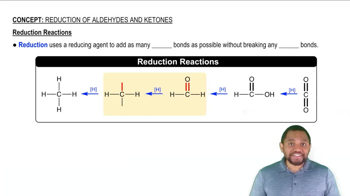
Reduction Reactions

Reduction reactions involve the gain of electrons or hydrogen, or the loss of oxygen in a chemical species. In organic chemistry, this often refers to the conversion of carbonyl compounds, such as aldehydes and ketones, into alcohols. Understanding the mechanism of reduction is crucial for determining whether a specific alcohol can be synthesized from a given carbonyl compound.
Video consigliato:
Percorso guidato
2:38
Reduction Reactions Concept 1

Aldehydes and Ketones

Aldehydes and ketones are both types of carbonyl compounds characterized by the presence of a carbonyl group (C=O). Aldehydes have at least one hydrogen atom attached to the carbonyl carbon, while ketones have two carbon groups attached. The structural differences between these compounds influence their reactivity and the types of products that can be formed through reduction.
Video consigliato:
Percorso guidato
1:57
Reduction of Aldehydes and Ketones Concept 2

Tertiary Alcohols

Tertiary alcohols are alcohols where the hydroxyl (-OH) group is attached to a carbon atom that is connected to three other carbon atoms. The compound in question, (CH₃)₃COH, is a tertiary alcohol. It cannot be formed directly by the reduction of an aldehyde or ketone, as these reactions typically yield primary or secondary alcohols, depending on the starting material.
Video consigliato:
Percorso guidato
1:10
Alcohol Classification Concept 2