Ch.15 Aldehydes and Ketones
McMurry - Fundamentals of General, Organic, and Biological Chemistry 8th Edition
McMurry8th EditionFundamentals of General, Organic, and Biological ChemistryISBN: 9780134015187Non è quello che usi tu?Cambia libro di testo
Capitolo 15, Problema 33b

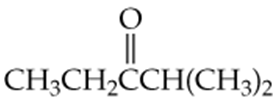
Give IUPAC names for the following aldehydes and ketones:
b.

Guida verificata passo dopo passo
1
Identify the functional group in each compound. Aldehydes have a carbonyl group (C=O) at the end of the carbon chain, while ketones have a carbonyl group within the carbon chain.
Determine the longest continuous carbon chain that contains the carbonyl group. This will serve as the parent chain, and its name will be based on the number of carbons (e.g., meth-, eth-, prop-, etc.).
For aldehydes, replace the '-e' ending of the parent alkane name with '-al'. For ketones, replace the '-e' ending of the parent alkane name with '-one'.
Number the carbon chain so that the carbonyl group gets the lowest possible number. For ketones, include the position of the carbonyl group in the name (e.g., 2-pentanone). Aldehydes do not require a position number since the carbonyl group is always at the end.
If there are substituents (e.g., alkyl groups or halogens), name and number them as prefixes, arranging them alphabetically in the final name. Ensure the substituents' positions are based on the numbering of the parent chain.

Risposta video verificata per un problema simile:

Questa soluzione video è stata consigliata dai nostri tutor come utile per risolvere questo problema.

Concetti chiave

Ecco i concetti essenziali che devi comprendere per rispondere correttamente alla domanda.

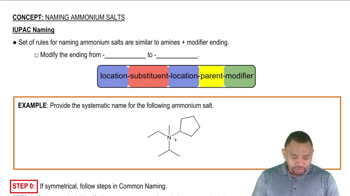
IUPAC Nomenclature

IUPAC nomenclature is a systematic method for naming chemical compounds. It provides rules for naming organic compounds based on their structure, functional groups, and the longest carbon chain. For aldehydes, the suffix '-al' is used, while for ketones, the suffix '-one' is applied. Understanding these rules is essential for accurately naming the compounds in the question.
Video consigliato:
Percorso guidato
3:18
IUPAC Naming Concept 3

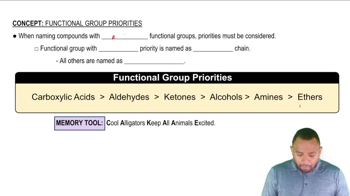
Functional Groups

Functional groups are specific groups of atoms within molecules that are responsible for the characteristic chemical reactions of those molecules. In the context of aldehydes and ketones, the carbonyl group (C=O) is the key functional group. Aldehydes have the carbonyl group at the end of the carbon chain, while ketones have it within the chain, which influences their naming and properties.
Video consigliato:
Percorso guidato
1:11
Functional Group Priorities Concept 1

Structural Isomerism

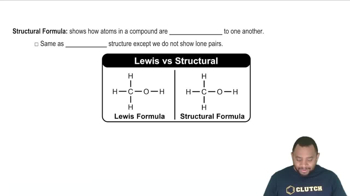
Structural isomerism occurs when compounds have the same molecular formula but different structural arrangements of atoms. This concept is crucial when naming aldehydes and ketones, as different structures can lead to different IUPAC names. Recognizing isomers helps in understanding the diversity of organic compounds and their nomenclature.
Video consigliato:
Percorso guidato
1:01
Structural Formula Concept 2