Ch.15 Aldehydes and Ketones
McMurry - Fundamentals of General, Organic, and Biological Chemistry 8th Edition
McMurry8th EditionFundamentals of General, Organic, and Biological ChemistryISBN: 9780134015187Non è quello che usi tu?Cambia libro di testo
Capitolo 15, Problema 8

Why do aldehydes and ketones have lower boiling points than alcohols with similar molecular weights? Why are their boiling points higher than those of alkanes with similar molecular weights?

Guida verificata passo dopo passo
1
Understand the intermolecular forces present in aldehydes, ketones, alcohols, and alkanes. Aldehydes and ketones exhibit dipole-dipole interactions due to the polar carbonyl group (C=O), while alcohols exhibit hydrogen bonding due to the hydroxyl group (-OH). Alkanes, being nonpolar, only exhibit weak London dispersion forces.
Compare the strength of intermolecular forces. Hydrogen bonding in alcohols is significantly stronger than dipole-dipole interactions in aldehydes and ketones, which explains why alcohols have higher boiling points than aldehydes and ketones of similar molecular weights.
Analyze why aldehydes and ketones have higher boiling points than alkanes. The polar carbonyl group in aldehydes and ketones leads to dipole-dipole interactions, which are stronger than the London dispersion forces present in nonpolar alkanes. This results in higher boiling points for aldehydes and ketones compared to alkanes of similar molecular weights.
Consider molecular weight and its role in boiling points. For compounds with similar molecular weights, the type and strength of intermolecular forces are the primary determinants of boiling points, rather than the molecular weight itself.
Summarize the relationship between boiling points and intermolecular forces: Alcohols > Aldehydes/Ketones > Alkanes, due to the presence of hydrogen bonding, dipole-dipole interactions, and London dispersion forces, respectively.

Risposta video verificata per un problema simile:

Questa soluzione video è stata consigliata dai nostri tutor come utile per risolvere questo problema.

Concetti chiave

Ecco i concetti essenziali che devi comprendere per rispondere correttamente alla domanda.

Hydrogen Bonding

Hydrogen bonding occurs when a hydrogen atom covalently bonded to a highly electronegative atom, like oxygen, interacts with another electronegative atom. Alcohols can form strong hydrogen bonds due to the presence of an -OH group, leading to higher boiling points. In contrast, aldehydes and ketones lack this capability, resulting in lower boiling points despite having similar molecular weights.
Video consigliato:
Percorso guidato
1:22
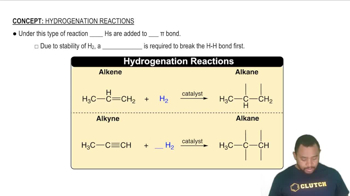
Hydrogenation Reactions Concept 1

Molecular Polarity

Molecular polarity refers to the distribution of electrical charge across a molecule. Aldehydes and ketones are polar due to the carbonyl group (C=O), which allows for dipole-dipole interactions, raising their boiling points above those of non-polar alkanes. However, these interactions are weaker than the hydrogen bonds in alcohols, explaining the lower boiling points of aldehydes and ketones compared to alcohols.
Video consigliato:
Percorso guidato
01:34
Molecular Polarity (Simplified) Concept 1

Van der Waals Forces

Van der Waals forces are weak intermolecular forces that arise from temporary dipoles in molecules. Alkanes, being non-polar, rely solely on these forces, resulting in lower boiling points. Aldehydes and ketones, while having stronger dipole-dipole interactions, still experience Van der Waals forces, which contribute to their boiling points being higher than those of alkanes with similar molecular weights.
Video consigliato:
Percorso guidato
02:25
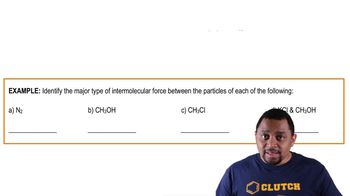
Intermolecular Forces (Simplified) Example 2