Ch.16 Amines
McMurry - Fundamentals of General, Organic, and Biological Chemistry 8th Edition
McMurry8th EditionFundamentals of General, Organic, and Biological ChemistryISBN: 9780134015187Non è quello che usi tu?Cambia libro di testo
Capitolo 16, Problema 7a

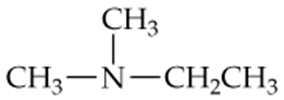
Arrange the following compounds in order of increasing boiling point. Explain why you placed them in that order.
a.

Guida verificata passo dopo passo
1
Identify the intermolecular forces present in each compound. Intermolecular forces include London dispersion forces, dipole-dipole interactions, and hydrogen bonding. Stronger intermolecular forces generally lead to higher boiling points.
Analyze the molecular structure of each compound to determine the types of intermolecular forces it exhibits. For example, check for polar bonds (dipole-dipole interactions) or the presence of -OH, -NH, or -FH groups (hydrogen bonding).
Consider the molecular weight of each compound. Larger molecules with greater molecular weights tend to have stronger London dispersion forces, which can increase the boiling point.
Compare the compounds based on the strength of their intermolecular forces and molecular weights. Arrange them in order of increasing boiling point, starting with the compound that has the weakest intermolecular forces and ending with the one that has the strongest.
Explain the reasoning behind the order. For example, if one compound has hydrogen bonding, it will likely have a higher boiling point than a compound with only London dispersion forces. Similarly, a larger molecule with stronger dispersion forces will have a higher boiling point than a smaller molecule with weaker forces.

Risposta video verificata per un problema simile:

Questa soluzione video è stata consigliata dai nostri tutor come utile per risolvere questo problema.

Concetti chiave

Ecco i concetti essenziali che devi comprendere per rispondere correttamente alla domanda.

Boiling Point

The boiling point of a substance is the temperature at which its vapor pressure equals the external pressure surrounding the liquid, causing it to change into a gas. It is influenced by intermolecular forces, molecular weight, and structural characteristics of the compounds. Generally, stronger intermolecular forces lead to higher boiling points.
Video consigliato:
Percorso guidato
03:05
Boiling Point Elevation Concept 1

Intermolecular Forces

Intermolecular forces are the forces of attraction or repulsion between neighboring particles (atoms, molecules, or ions). The main types include hydrogen bonding, dipole-dipole interactions, and London dispersion forces. Compounds with stronger intermolecular forces typically exhibit higher boiling points due to the increased energy required to overcome these forces during the phase change from liquid to gas.
Video consigliato:
Percorso guidato
01:59
Intermolecular Forces (Simplified) Concept 1

Molecular Weight

Molecular weight, or molar mass, is the mass of a molecule calculated as the sum of the atomic weights of its constituent atoms. Generally, as molecular weight increases, the boiling point also tends to increase due to greater London dispersion forces, which arise from temporary dipoles in larger molecules. However, this trend can be influenced by the presence of functional groups and the overall molecular structure.
Video consigliato:
Percorso guidato
02:08
Molecular Formula