
Benzene and pyridine are both single-ring, aromatic compounds. Benzene is a neutral compound that is insoluble in water. Pyridine, with a similar molar mass, is basic and completely miscible with water. Explain these phenomena.
Ch.16 Amines
McMurry8th EditionFundamentals of General, Organic, and Biological ChemistryISBN: 9780134015187Non è quello che usi tu?Cambia libro di testo
Capitolo 16, Problema 55
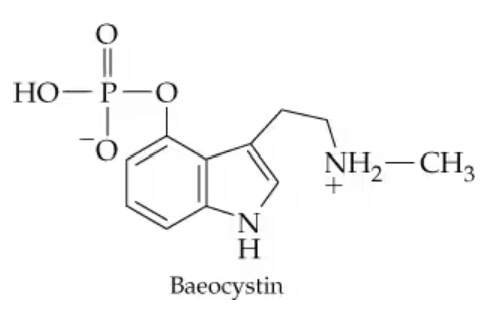
Baeocystin is a hallucinogenic compound that is isolated from the mushroom Psilocybe baeocystis and has the structure shown below. What heterocyclic base (Table 16.1) is the parent of this compound?

Guida verificata passo dopo passo1
Examine the structure of baeocystin provided in the problem. Identify the heterocyclic ring system present in the molecule. A heterocyclic ring contains at least one atom other than carbon (e.g., nitrogen, oxygen, or sulfur) within a cyclic structure.
Compare the heterocyclic ring in baeocystin to the common heterocyclic bases listed in Table 16.1. Look for similarities in the number of atoms in the ring, the type of heteroatom(s) present, and the overall structure.
Determine if the heterocyclic ring in baeocystin matches any of the parent heterocyclic bases in Table 16.1. Pay attention to functional groups or substituents that may be attached to the ring, as these do not change the identity of the parent base.
Once the parent heterocyclic base is identified, confirm your choice by ensuring that the core structure of the heterocyclic ring in baeocystin is identical to the structure of the parent base.
State the name of the parent heterocyclic base that corresponds to the structure of baeocystin. This will be the answer to the problem.

Risposta video verificata per un problema simile:
Questa soluzione video è stata consigliata dai nostri tutor come utile per risolvere questo problema.
Concetti chiave
Ecco i concetti essenziali che devi comprendere per rispondere correttamente alla domanda.
Heterocyclic Compounds
Heterocyclic compounds are cyclic structures that contain at least one atom in the ring that is not a carbon atom, typically nitrogen, oxygen, or sulfur. These compounds are significant in various fields, including pharmaceuticals and natural products, as they often exhibit unique chemical properties and biological activities. Understanding the structure and classification of heterocycles is essential for identifying parent compounds in complex molecules.
Video consigliato:
Percorso guidato
Naming Ionic Compounds
Psilocybe baeocystis
Psilocybe baeocystis is a species of mushroom known for its psychoactive properties, primarily due to the presence of compounds like baeocystin and psilocybin. This mushroom is part of the larger Psilocybe genus, which is renowned for its hallucinogenic effects. Familiarity with this species helps in understanding the context of the compounds derived from it and their potential effects on the human brain.
Baeocystin
Baeocystin is a naturally occurring hallucinogenic compound found in certain mushrooms, particularly Psilocybe baeocystis. It is structurally related to psilocybin and is believed to contribute to the psychoactive effects of the mushrooms. Identifying the parent heterocyclic base of baeocystin is crucial for understanding its chemical properties and its relationship to other psychoactive compounds.
Pratica correlata
Domanda del libro di testo
40
views
Domanda del libro di testo
Complete the following equations (Hint: Answers may include concepts learned from previous organic chapters):
c.
670
views
Domanda del libro di testo
Lemon juice, which contains citric acid, is traditionally recommended for removing the odor associated with cleaning fish. What functional group is responsible for a 'fishy' odor, and why does lemon juice work to remove the odor? If possible, test this at home using a piece of fish.
65
views
Domanda del libro di testo
Complete the following equations (Hint: Answers may include concepts learned from previous organic chapters):
a.
601
views
Domanda del libro di testo
Complete the following equations (Hint: Answers may include concepts learned from previous organic chapters):
e.
885
views
